The 12 brand archetypes, on one map
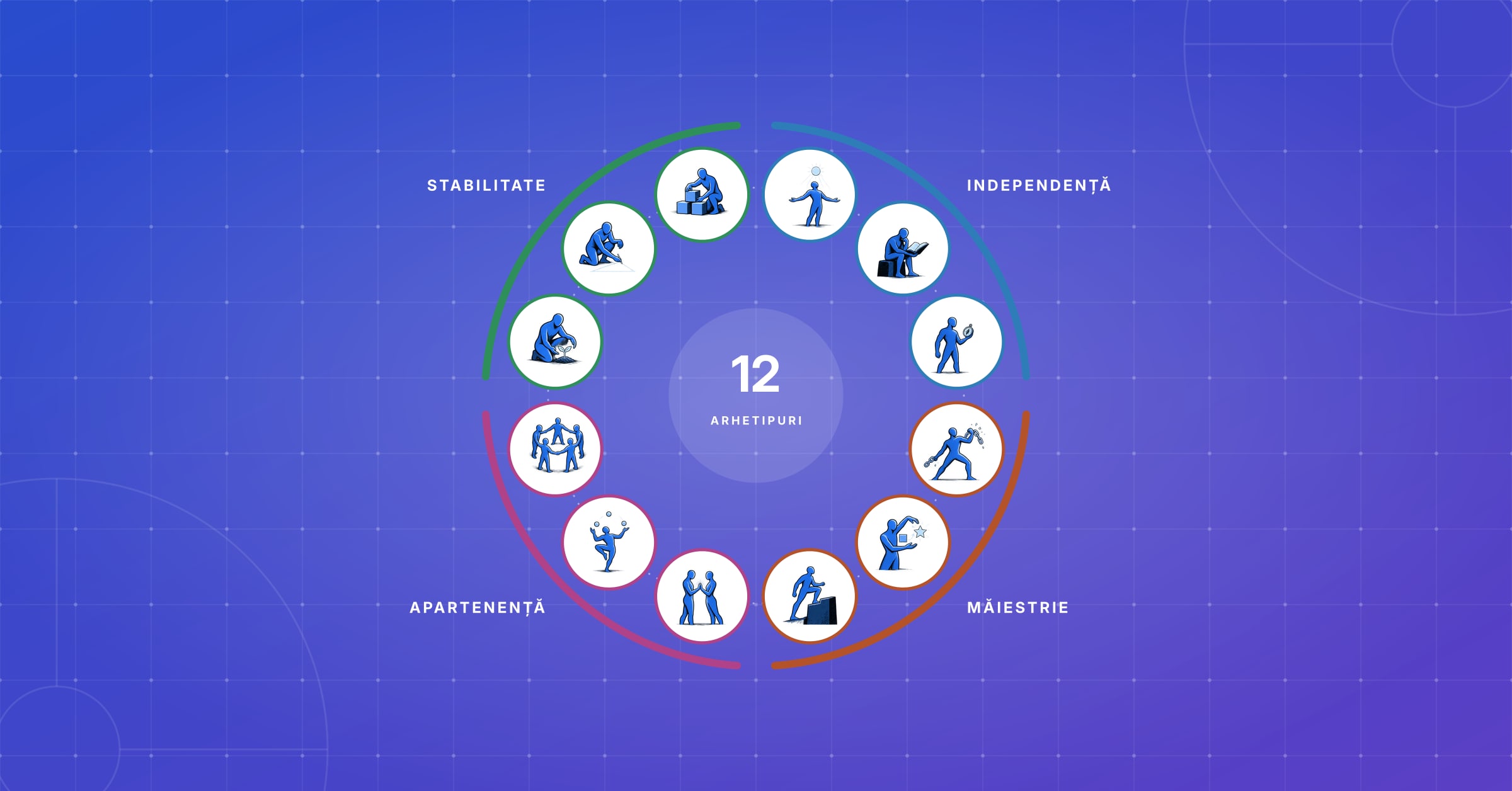
The 12 brand archetypes are the Innocent, the Sage, the Explorer, the Outlaw, the Magician, the Hero, the Lover, the Jester, the Everyman, the Caregiver, the Creator and the Ruler, grouped into four motivations. In ACM Framework, each has a card that says what it does, how it speaks and where its limit lies.
Dumitru Talmazan
Picture a Saturday morning walk through town, past twelve shop windows. Each one tells you something before you go in: one promises calm, another an adventure, another that you will feel at home. Twelve windows, twelve characters.
01What are the 12 brand archetypes?
The Innocent, the Sage, the Explorer, the Outlaw, the Magician, the Hero, the Lover, the Jester, the Everyman, the Caregiver, the Creator and the Ruler. They are twelve basic characters by which people recognise a story, and brands use them to be recognised just as quickly.
In the Archetypal Coherence Matrix (ACM Framework), the twelve are a ruler, not a label. Each has a card that says what it does, how it speaks and where its limit lies, and any perspective on a brand is spread across all twelve, as a profile.
02Why are they grouped into four families?
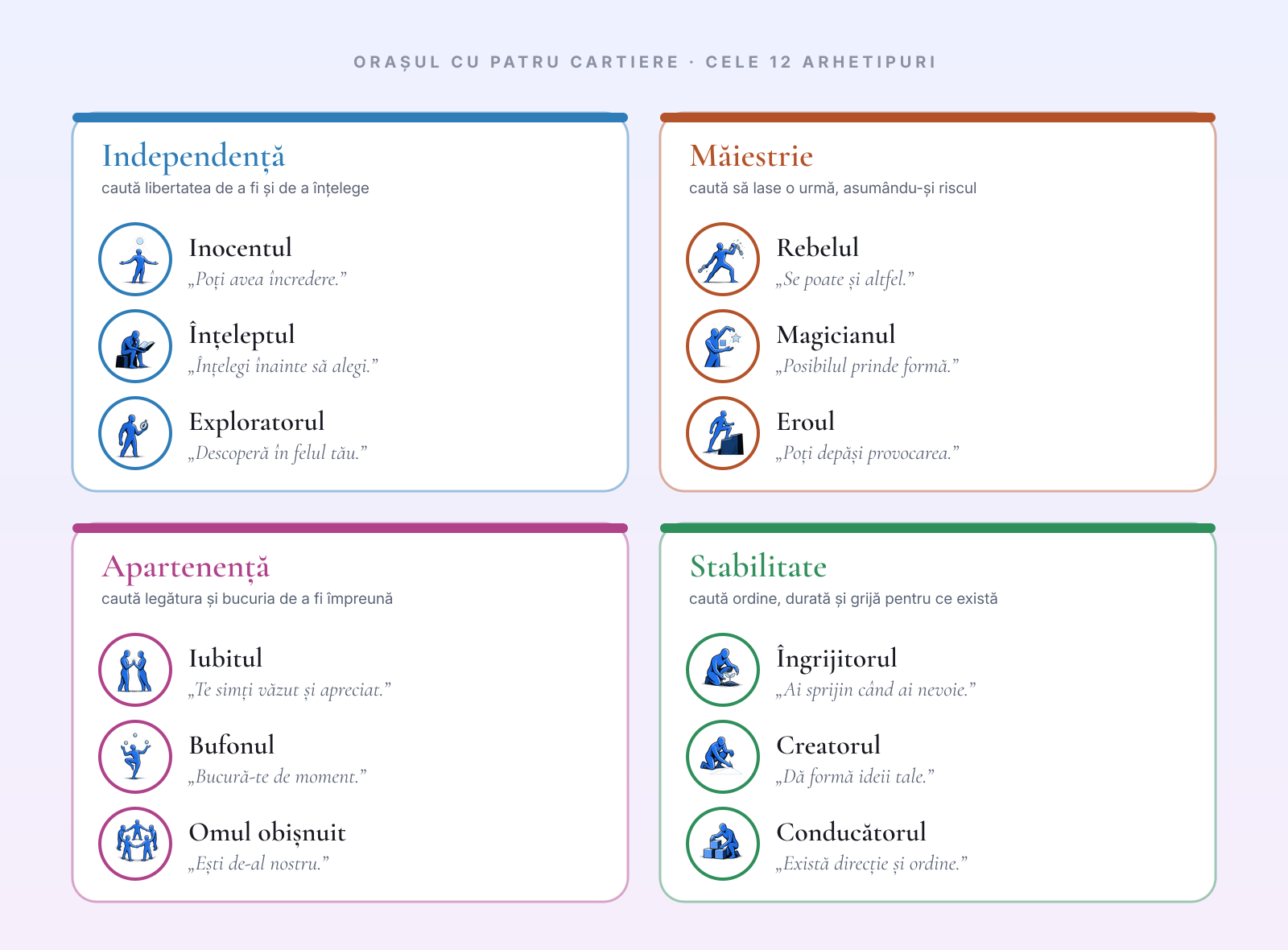
Because the archetypes in each family come from the same basic desire. The four families are four motivations: independence, mastery, belonging and stability.
Let’s imagine the town as four neighbourhoods. In one, people want to be free and to understand things for themselves. In another, they want to leave a mark and they take the risk. In the third, they seek the company of others. In the fourth, they want order, permanence and care for what already exists.
The neighbourhoods do not enter any calculation. Distance is measured across all twelve archetypes. The grouping helps with coding: anyone who hesitates usually hesitates between neighbours in the same neighbourhood.
03Which archetypes seek independence?
The Innocent, the Sage and the Explorer. All three want people to choose freely: one by simplifying, another by explaining, the third by opening new paths.
- The Innocent · “You can trust this.” The brand simplifies choice and offers a sincere experience that is easy to understand. You recognise it in a neighbourhood pharmacy, with a white shop window and few words. The limit: simplicity can turn into naivety if it avoids real complexity.
- The Sage · “Understand before you choose.” The brand explains, asks questions and backs its claims with arguments and evidence. You recognise it in a training centre, with posters that explain before they sell. The limit: too much explaining can create distance or delay the decision.
- The Explorer · “Discover it your way.” The brand opens up possibilities and encourages direct experience, one’s own choice and going beyond the familiar. You recognise it in an outdoor gear shop, with maps stuck to the window. The limit: constant searching can make the direction hard to follow.
04Which archetypes seek mastery?
The Outlaw, the Magician and the Hero. All three want to change something: the rules, the way things look, or people’s limits.
- The Outlaw · “There is another way.” The brand challenges conventions and offers an explicit alternative to the usual way of doing things. You recognise it in a barber shop with its own rules, chalked up at the entrance. The limit: provocation without a real alternative can remain mere noise.
- The Magician · “The possible takes shape.” The brand links a vision to a perceptible change and makes the passage from before to after intelligible. You recognise it in an interior design studio, with “before and after” photos. The limit: a promise of transformation needs proof; otherwise it looks like an illusion.
- The Hero · “You can overcome the challenge.” The brand takes on a challenge, shows the effort and demonstrates the ability to see things through. You recognise it in a tool shop, with drills that promise to get the job done. The limit: the pressure to prove itself all the time can become exhausting.
05Which archetypes seek belonging?
The Lover, the Jester and the Everyman. All three want people to feel connected to others: appreciated, amused, or accepted as they are.
- The Lover · “You feel seen and appreciated.” The brand cultivates connection, attention to detail and an experience that makes people feel appreciated. You recognise it in a florist’s, where every bouquet seems made just for you. The limit: aesthetics and seduction can hide a lack of substance.
- The Jester · “Enjoy the moment.” The brand makes room for joy, shifts perspective through humour and creates complicity with its audience. You recognise it in an escape room, with a window that makes you smile before you go in. The limit: misplaced humour can undermine trust or exclude people.
- The Everyman · “You’re one of us.” The brand speaks as an equal and creates the feeling that the experience is within reach of people like you too. You recognise it in a neighbourhood supermarket, with prices written large and people who say hello. The limit: the wish to resemble everyone can erase the differences that matter.
06Which archetypes seek stability?
The Caregiver, the Creator and the Ruler. All three want things to last: through care, through work done well, or through order.
- The Caregiver · “You have support when you need it.” The brand notices needs, reduces vulnerability and offers attentive help without cancelling the other person’s autonomy. You recognise it in a private nursery, with the children’s drawings in the window. The limit: care can become paternalism if it decides on the person’s behalf.
- The Creator · “Give your idea a shape.” The brand gives shape to ideas, commits to original choices and shows care for work done well. You recognise it in a pottery workshop, where you can see the potter’s wheel from the street. The limit: perfectionism can get in the way of finishing and of use.
- The Ruler · “There is direction and order.” The brand sets the direction and the standards, organises resources and takes responsibility for its decisions. You recognise it at the headquarters of a big bank, with marble and heavy doors. The limit: authority can become rigidity or excessive distance.
07What is written on an archetype’s card?
What the brand does, how it speaks, what it usually does and what it avoids, which businesses it suits and where its limit lies. The card describes behaviours that can be seen, not impressions.
In the platform, the twelve cards sit in the archetype library, each with its own symbol. For the owner, the card also has a part written in plain language: how you can tell you are this archetype and which trap you fall into most easily. For the Caregiver, for example, the trap is care that decides on the person’s behalf.
The card also lists the archetype’s desire and fear. They help understanding, but they are never coded, because a coder cannot see a brand’s fear in a post. Only what the brand does is measured.
The gain is bigger than it looks. When the whole team reads the same card, the word “Caregiver” means the same thing to the director, to whoever writes the copy and to whoever shoots the video.
08Does a brand have only one archetype?
No. Every brand has a mixed profile, with 100 points spread across all twelve archetypes. The first one is the base, and around it sit the secondary and supporting archetypes. You can see your brand’s profile in the brand archetype test.
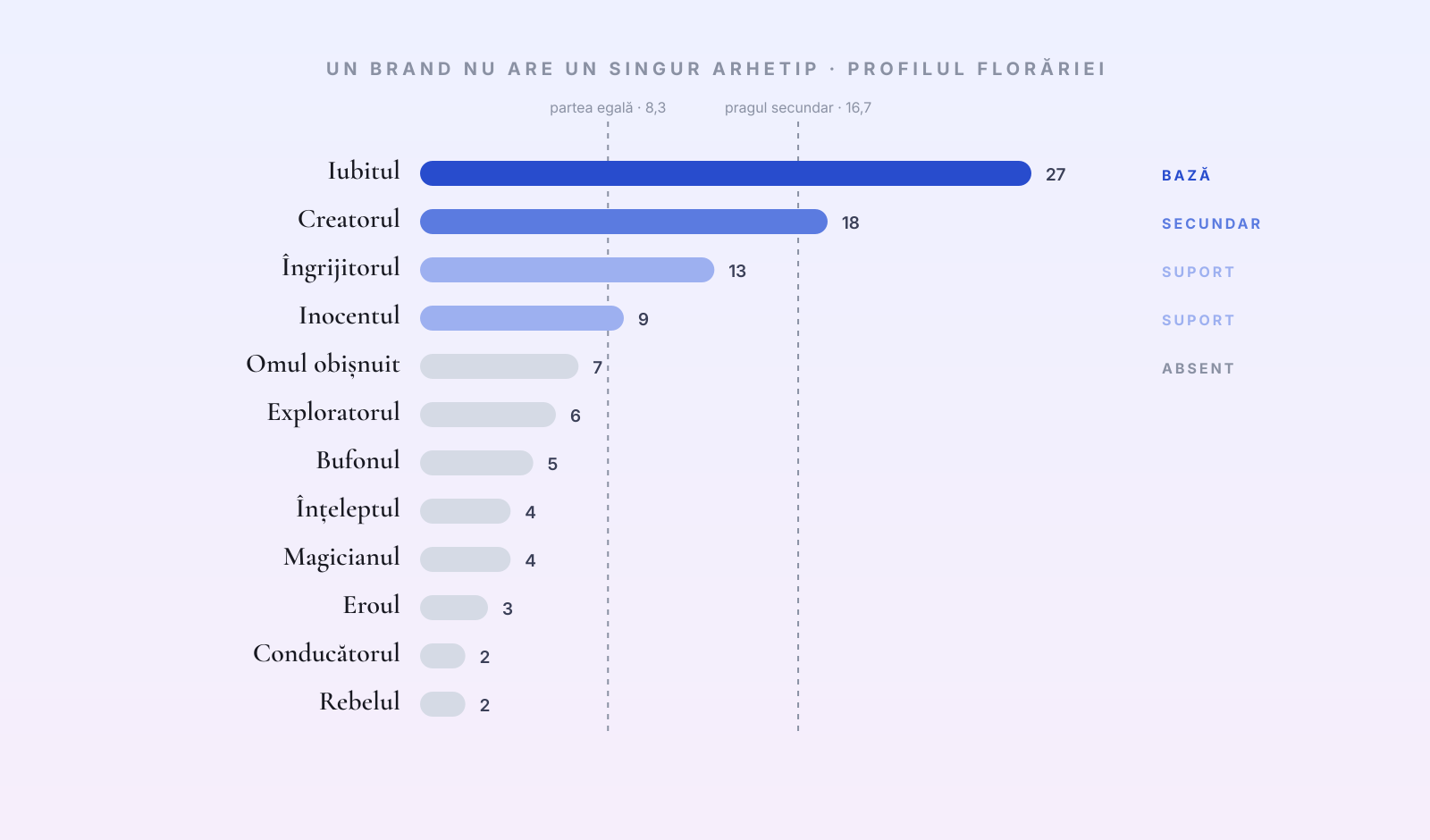
The florist’s on the corner, for example, is first of all a Lover: every bouquet is made so that you feel seen. But it is also a Creator, because the arrangements are its own, and a little bit of a Caregiver, because the florist asks you who the flowers are for. The thresholds are simple: an archetype is secondary if it has at least double the equal share, that is, more than 16.7 points, and it is supporting between 8.3 and 16.7.
When no archetype goes above 16.7, the profile is flat and the brand does not yet have a clear peak. When the top two are too close to tell apart, the instrument says the brand has two bases. Both are information, not mistakes.
09Why don’t we give examples of famous brands?
Because no famous brand has been measured with ACM Framework. The branding literature gives examples for each archetype, and the instrument keeps them as illustrations, but they have no profile, no distance and no percentage. The archetypes come from Jung’s vocabulary, but they are not a horoscope: what ACM Framework takes from Jung.
There is another reason, a more important one. A real brand is never a single archetype, and the same brand appears in different books with different archetypes. That is exactly what ACM Framework measures: not which label a brand has, but how far what it declares is from what it does (the six gaps).
On the way back, try a game: guess the character of each window before you go in, then check whether the character inside is the same one the window promised. Where it isn’t, that is where measurement begins.
About the examples in this article. The walk, the shop windows and the florist’s are imaginary. The archetype names, the manifestos, the behaviours, the limits, the four motivations and the profile thresholds come from the ACM Framework cards, published on Zenodo (https://doi.org/10.5281/zenodo.23459307). The grouping by motivation follows the work of Mark and Pearson (2001).