
Believes, Does, Expects, Sees: four brand perspectives
ACM Framework looks at a brand from four places: what management believes, what the brand publishes, what the customer expects from the category and what the customer who knows the brand sees. All four answer the same 12 statements, so they can land on the same map.
Dumitru Talmazan
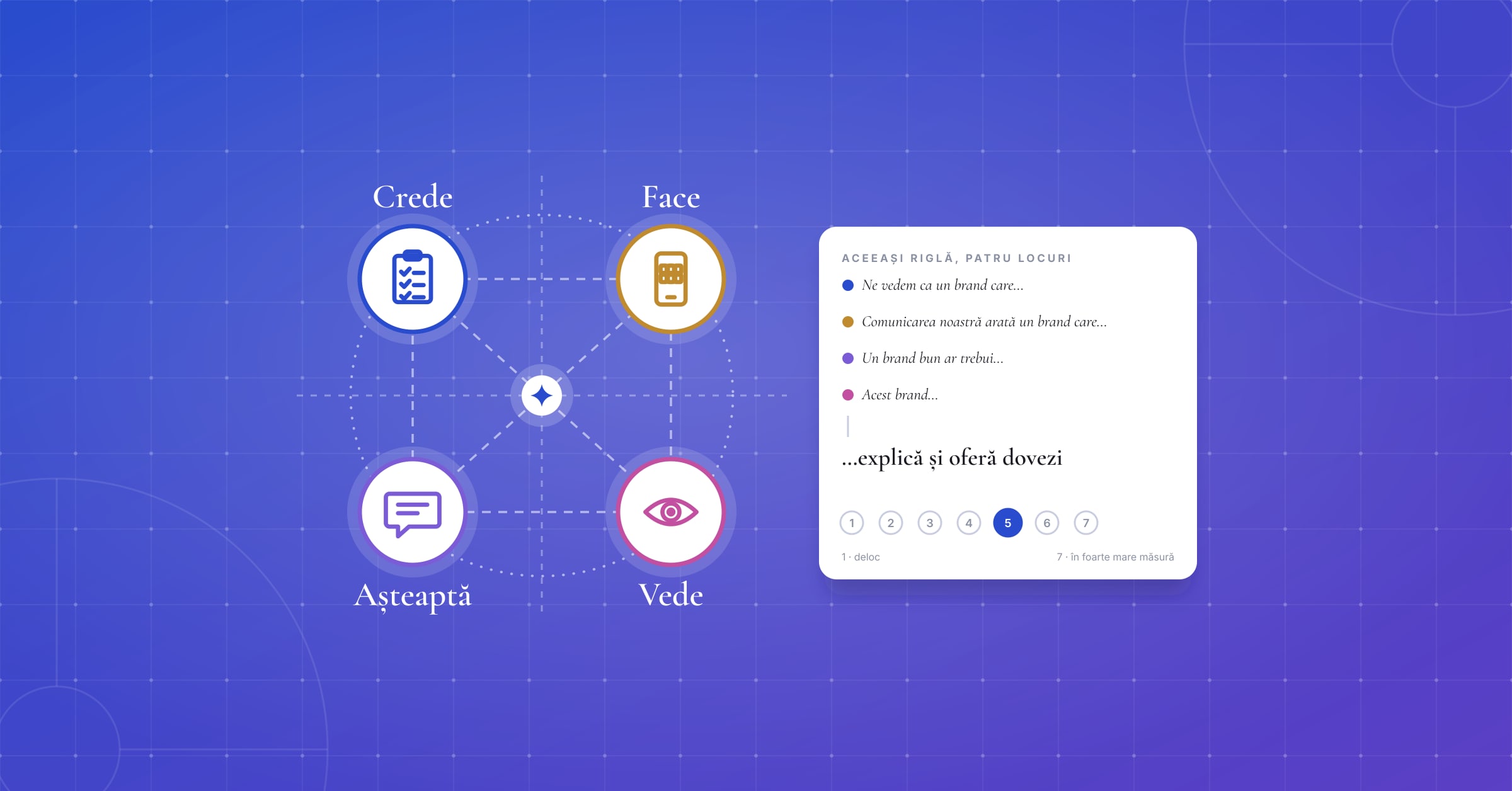
In the last article I sat by the window of a café and listened to four people describing four different places. Today I go back to the same café with another question: how do you ask each of them, so that their answers can be set side by side?
01What are the four perspectives of a brand?
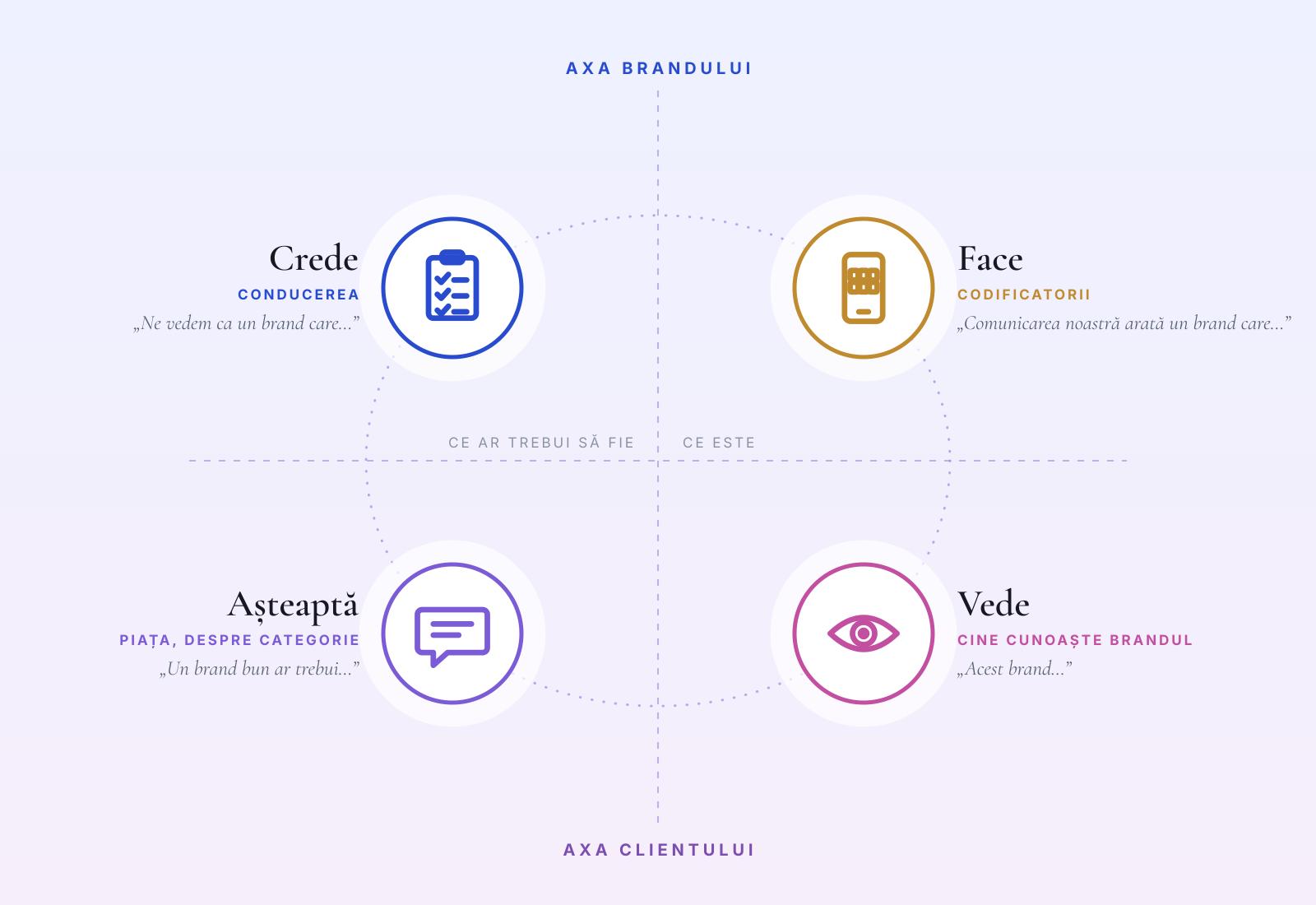
They are Believes, Does, Expects and Sees: what management believes, what the brand publishes, what the customer expects from the category and what the customer who knows the brand sees. Two come from the brand’s side, two from the customer’s.
I picture them as four windows of the same café. Through the first you look from the owner’s office, in the evening, after closing. Through the second, from the phone of someone scrolling on the bus. Through the third, from the mind of someone who hasn’t come in yet but knows what they want from a café. Through the fourth, from the table of the customer who has been coming here for two years.
- Believes: what management believes about the brand
- Does: what the brand publishes on its channels
- Expects: what the client expects from the category
- Sees: how the market sees the brand
The windows are not placed at random. At the top is the brand, at the bottom the customer. On the left is what should be, on the right what is. Two questions with two answers each give exactly four places, no more, no fewer.
02Why do all four answer the same 12 statements?
So they can be compared. If each were asked something different, you would have four opinions. This way, you have four measurements taken with the same ruler.
The ruler has 12 statements, one for each archetype: “explains and provides evidence”, “brings fun and humour”, “cares for people” and the rest. Each is scored from 1, “not at all”, to 7, “to a very great extent”. The only thing that changes is the start of the sentence, that is, the place the person answers from.
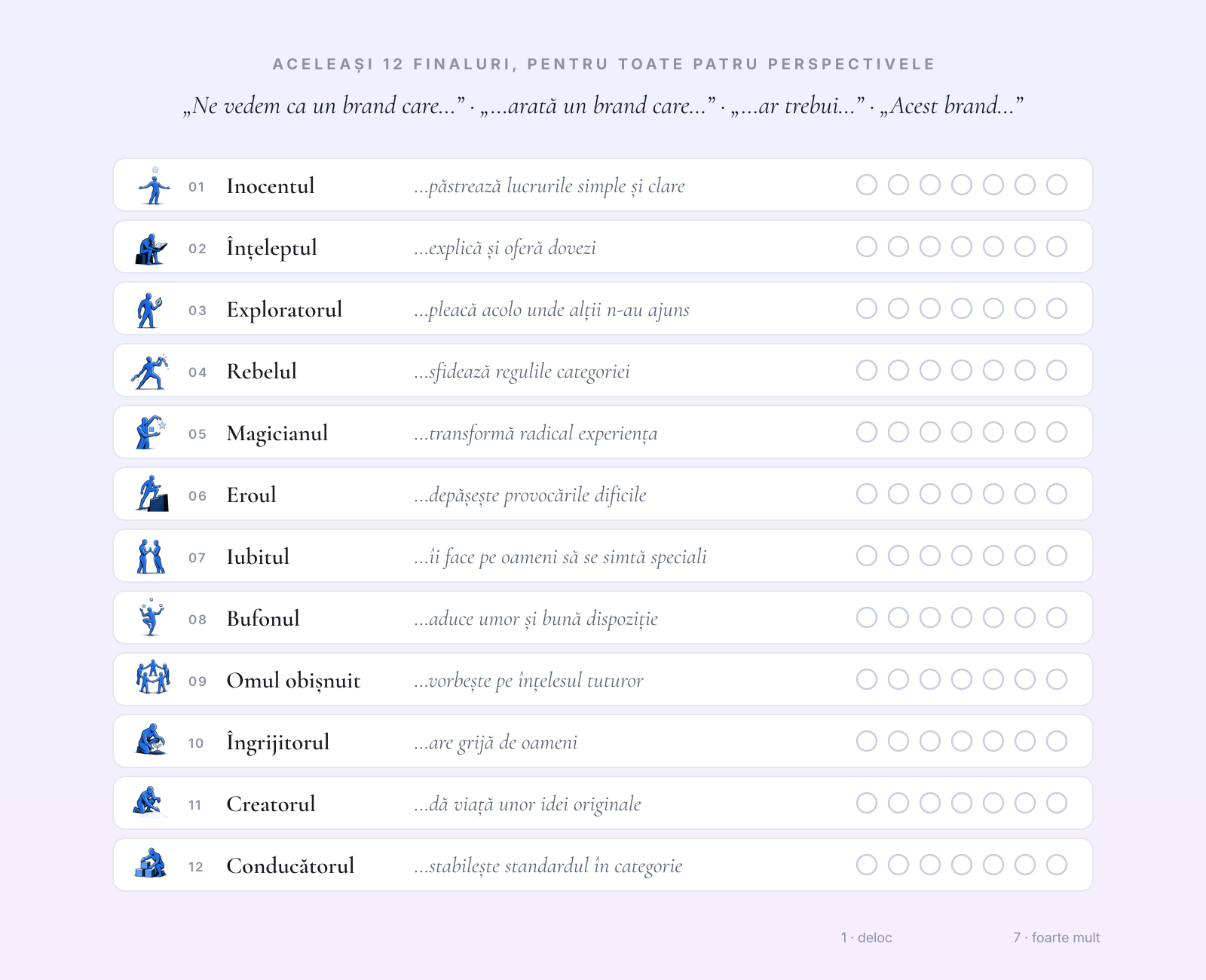
Four sentence beginnings, the same 12 endings. Everything rests on this: it is how four different opinions end up on the same map.
The order of the statements is shuffled for each person, so nobody answers out of habit. At the end, the scores become a profile across the 12 archetypes, on the same scale for all four perspectives.
03How is Believes collected?
Through the management survey: at least three people who make decisions in the brand answer the 12 statements, each on their own, without seeing what the others answered. With five to eight people, the result is more reliable.
I picture the café owner in the evening, phone in hand. He gets a link that is his alone. He reads “We see ourselves as a brand that…” and pauses at every statement. It isn’t a test, and there is no right answer. It may be the first time anyone has asked him to say, on a scale, who he believes he is.
If people don’t have time, it can also be filled in during a meeting, with help, and the platform marks it as such. Employees can answer the same survey, but their result is kept separate, as a team layer, and is not mixed into management’s average.
The gain is simple: intention is no longer a sentence from a presentation. It becomes a profile you can set beside the other three.
04How is Does collected?
From what the brand has published in the last three months, channel by channel. Nobody from the brand answers here: the materials are read by coders, against the same 12 statements.
This is the part I like most, because it resembles what any curious customer does. You open the café’s Instagram, its website, its Facebook page, and you ask yourself honestly: what kind of brand does all this show?
On the platform you add the channels where the brand is active, then the materials, and each channel gets its own profile. That way you see not only what the brand says in general, but also where it has started to speak differently.
When two coders read the same materials, how far they agree is checked too. There is a separate article on this, because it is one of the loveliest lessons about measurement.
05How are Expects and Sees collected?
From a single public survey, in a fixed order. First the person says what a good brand in the category should be like, without hearing the brand’s name. Only then, if they know it, do they say what they see in it.
The woman at the next table gets the survey. The first question isn’t about our café. It is about what “a good café” means to her, and she answers freely, with no name in mind. Only after that does the café appear, and only now do we ask her to say what she sees.
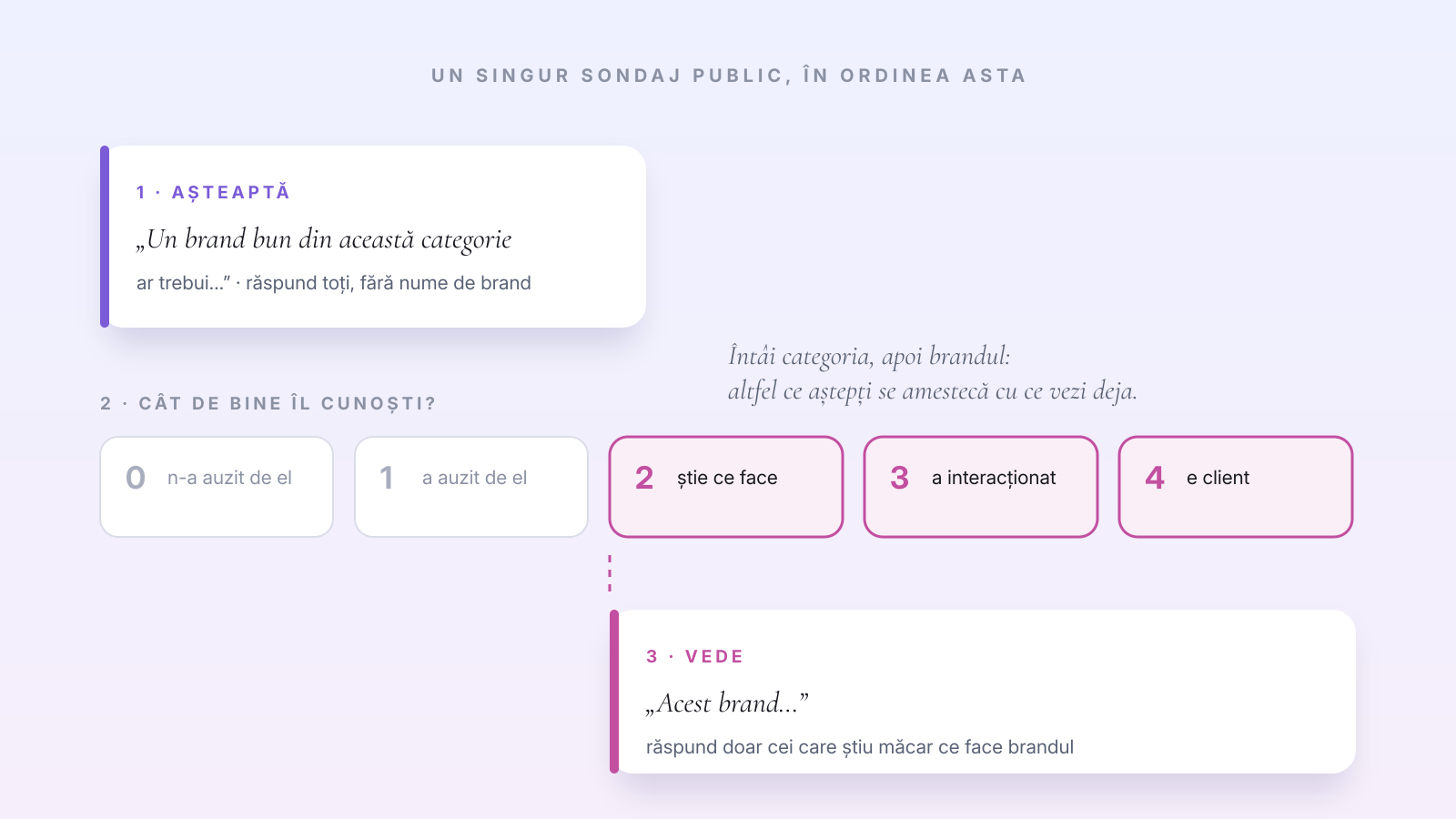
Not everyone answers about the brand. The person first says how well they know it, from “never heard of it” to “I’m a customer”. Only those who at least know what the brand does answer Sees. The others have already contributed to Expects, and their answer counts just as much.
The category norm appears from 150 complete responses, and Sees is calculated only if at least 40% of people know the brand. Below the threshold, the platform doesn’t invent a number: it tells you on screen why it is missing.
For the brand, this means two things learned from a single survey: what the market expects from the whole category and what it sees in you.
06What do you have once you have collected all four?
Four profiles on the same map, between which six gaps are calculated. From them come the diagnosis and the first step.
In our café, the map would show the owner’s Creator, the Jester on Instagram, the Caregiver people are looking for and the Everyman they find. Four windows, one view.
- Set up the brand: identity, declaration, audience, channels and the conditions of measurement, all dated.
- Send the personal links to management.
- Add the materials by channel and code them.
- Launch the public survey.
- Read the map in the Command Centre.
You don’t have to do everything at once. You can start with just Believes and Does, without a public survey, and the map fills in as the data comes in.
I left the café at dusk, as the lights were coming on. From the pavement you could see only one window, the one facing the street, and through it only part of the room. That is roughly what most confident opinions about a brand look like: true, but seen through a single window. ACM Framework opens all four.
About the example in this article. The café and the people in it are imaginary. The statements, scales and thresholds come from the published ACM Framework instrument.