Six gaps, six questions about your brand
A gap is the distance between two perspectives on the same brand: how many points you would have to move for the profiles to match. ACM Framework measures six gaps, each with its own question, from “does it do what it says?” to “how far does it depart from the norm?”.
Dumitru Talmazan
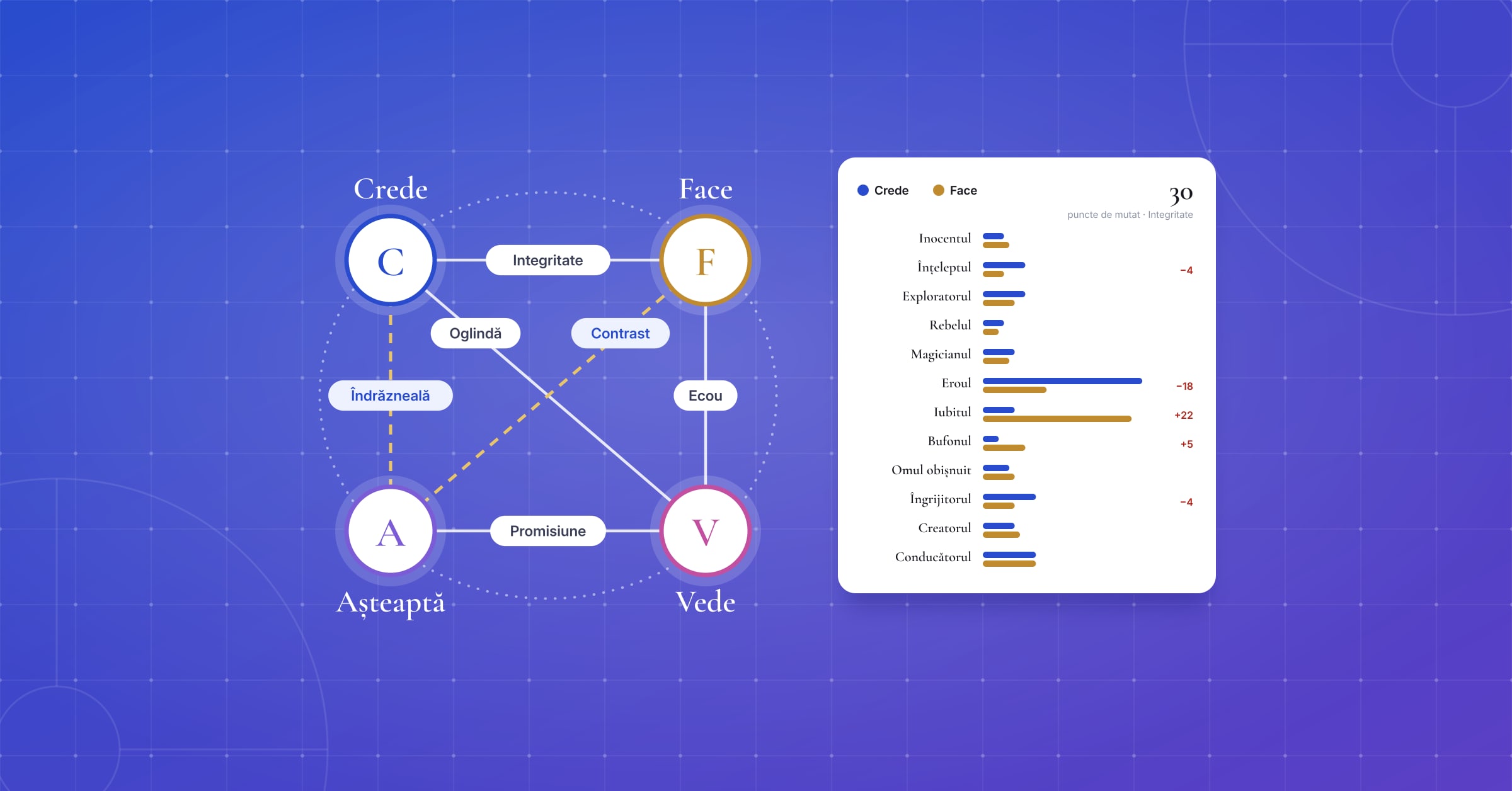
A year ago a fitness studio opened next to my block of flats. A small one, with mirrors on one wall and music a little too loud. I put the four views of it on the same map. Now I am interested in what lies between them: between four points you can stretch exactly six threads, and each one asks the brand a question that, usually, nobody says out loud.
01What is a gap?
A gap is the distance between two profiles of the same brand, from 0 to 100. It tells you how many points you would have to move in one profile to make it identical to the other.
I picture it as two playlists of 100 tracks each, split across 12 genres, one for each archetype. The first was made by the owner, from what he believes about the studio: lots of Hero tracks, beats that push you to do one more rep. The second was made by someone who looked closely at the studio’s Instagram: lots of Lover tracks, warm light, beautiful bodies, magazine shots. The gap is the number of tracks you have to swap for the two playlists to sound the same.
At our studio, 30 tracks would have to be swapped between Believes and Does. Most of them move from Hero to Lover. The figure says how big the distance is, and the genres show which way the brand has drifted.
A gap is not a grade for the brand. It is a distance between two views of it, and each distance has its own name.
02What are the six gaps?
Integrity, Legibility, Mirror, Promise, Contrast and Boldness. Each one links two perspectives and asks a single question.
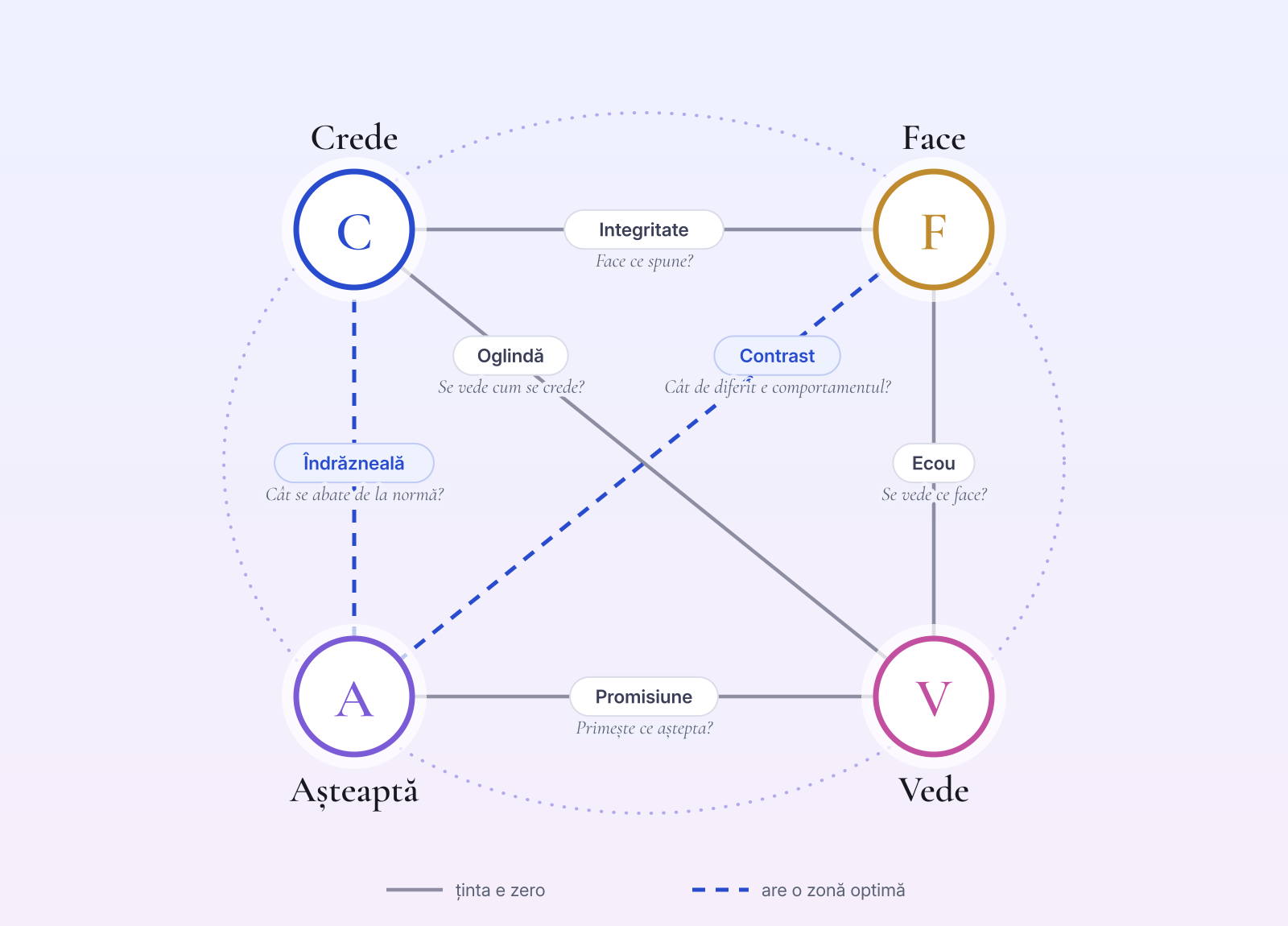
This is not a list picked to taste. Four perspectives give exactly six pairs, so no question is missing and none is extra.
03What does Integrity ask?
It asks whether the brand does what it says. It sets what management believes, Believes, against what the brand publishes, Does.
It is the first thread I check, because it is the most uncomfortable. The studio owner talks about pushing past limits and about people who change, while Instagram mostly shows how good the people who have already changed look. When Integrity is large, the problem is not communication but behaviour, and no campaign fixes it. That is why it also carries the largest weight in the index, a quarter of the whole.
04What does Legibility ask?
It asks whether what the brand does is seen. It sets what the brand publishes, Does, against what a client who knows it sees, Sees.
Sometimes a brand publishes exactly what it should, but people remember something else. The studio posts every day, carefully, yet members talk only about the new machines and the price of membership. A large Legibility gap says the effort is there; it just doesn’t reach people. This really is a communication problem, and it is fixed faster than the others.
05What does the Mirror ask?
It asks whether the brand is seen as it believes itself to be. It sets what management believes, Believes, against what the client sees, Sees.
This is the thread that most often surprises management. The owner sees himself as the coach who gets you off the sofa, while the client sees a demanding place for people who are already fit, a Ruler setting the standard. I imagine him reading this figure for the first time: not anger, more like silence. The Mirror shows what you cannot find out from behind the reception desk.
06What does the Promise ask?
It asks whether the client gets what they expected. It sets what people expect from a good studio, Expects, against what they find at yours, Sees.
A woman getting back into exercise after a long break wants, above all, not to feel judged and not to get injured. She is looking for a Caregiver and finds a place that is immaculate but cold. The Promise does not ask whether the brand is coherent with itself, but whether it matches what people are looking for. That is why it is not part of the coherence axis: a brand that chooses to be different will always have a distance here.
07What does Contrast ask?
It asks how differently the brand behaves from what the market expects. It sets what the brand publishes, Does, against the category norm, Expects.
Here zero is not a win. A studio that behaves exactly like all the others is fine, but easy to replace. Too far, on the other hand, and people no longer recognise the category. Contrast has an optimal zone, around 20 points, and our studio’s magazine aesthetic, in a category where people are looking for care, is worth checking precisely against that zone.
08What does Boldness ask?
It asks how far the brand wants to depart from the norm. It sets what management believes, Believes, against what the market expects, Expects.
Boldness is about intention, not facts. A Hero among Caregivers is a brave choice and may be exactly what makes the studio irreplaceable for someone who wants to be pushed. Like Contrast, it has an optimal zone. But it carries the smallest weight in the index, because an intention only counts once it shows in behaviour.
09How do you read a gap’s figure?
It depends on the gap. For Integrity, Legibility, Mirror and Promise, the target is zero: below 15 is small, between 15 and 25 is moderate, above 25 is large. For Contrast and Boldness you look for an optimal zone, around 20.
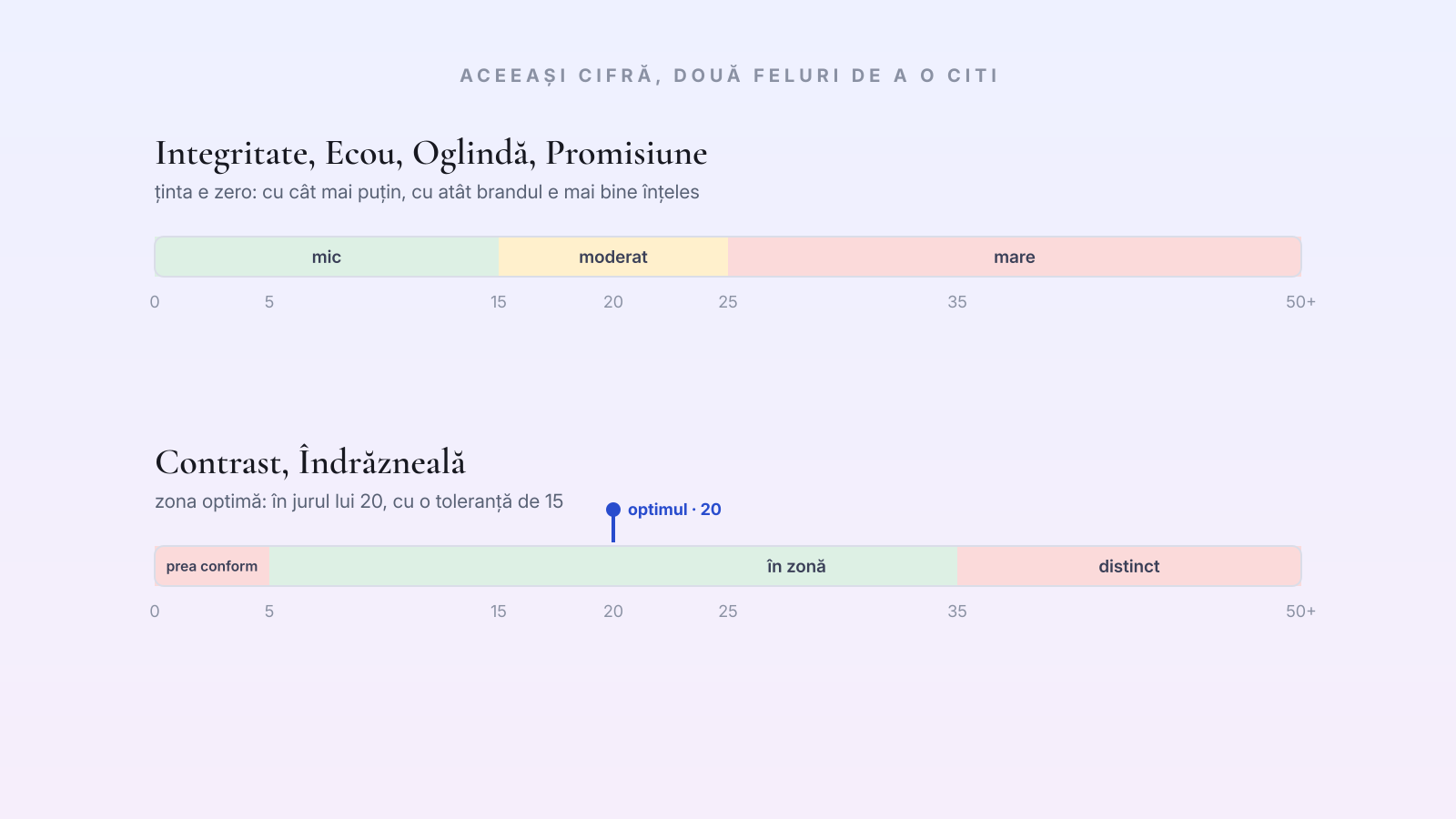
One thing I always tell people seeing the table for the first time: zero is never reached. Two profiles measured by different people always have a little noise between them, even when the brand is perfectly coherent. That is why the band matters, not the exact figure.
10Where do you see the six gaps on the platform?
In the Command Centre, in a single table: each gap with its question, its figure and the band it falls into. Three of them, Integrity, Legibility and Mirror, make up the coherence axis of the diagnosis.
They don’t all appear at once. Each tier of measurement opens new threads, and the platform never fills in a gap from data that is missing.
- The Internal coherence audit, with Believes and Does, opens Integrity.
- With perception, when Sees is added, Legibility and the Mirror appear.
- The Full diagnosis, with Expects, opens the Promise, Contrast and Boldness, plus the index.
The index, the weighted average of the six, appears only at the third tier. Calculated from missing perspectives, it would not be an approximation but a false figure.
When a brand “isn’t working”, the temptation is to look for a single culprit. At the studio next to my block there isn’t one. Saying one thing and doing another, doing well without it being seen, and being too well-behaved for the category are three different threads, fixed in three different ways. The first step is to find out which of them has snapped.
About the example in this article. The fitness studio and its profiles are imaginary, and the figure of 30 is calculated on them, as an example. The names of the gaps, the questions, the thresholds and the weights come from the published ACM Framework instrument.