Four people, four cafés: a brand has four characters
Brand coherence is the distance between four pictures of the same brand: what management believes, what the brand publishes, what the client expects from the category and what they actually see. ACM Framework puts them on the same map and shows where the picture breaks and what to fix first.
Dumitru Talmazan
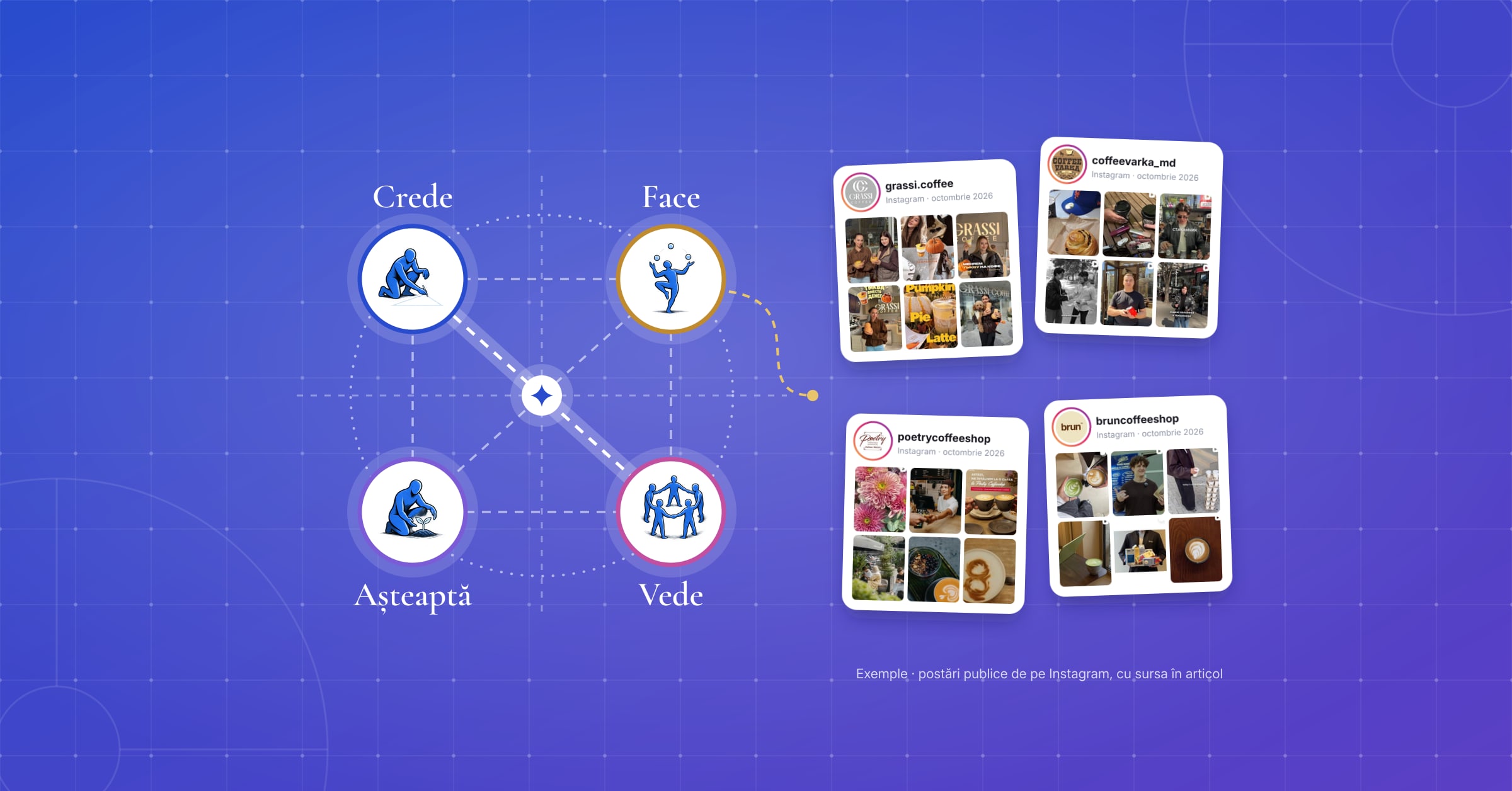
I'm starting this series with a habit I've had for years: I look at brands as if they were people. I listen to how they talk, I watch what they do and I notice how others look at them. Almost every time I see the same thing: a brand doesn't have one character. It has four.
01What do four people say about the same café?
They say four different things, and all of them are right. Each one sees the café from where they stand.
It's eight in the morning. I walk into the café on the corner, the one I've been coming to for two years. It smells of freshly ground beans, and the barista knows my order before I say it. I sit by the window and, out of curiosity, I start to listen.
The owner is talking to a supplier at the counter: “We don't make coffee like everyone else. We choose the beans, we invent recipes.” In his voice you can hear a Creator, someone building something of his own.
I open my phone and go to the café's Instagram. Memes, giveaways, “guess the secret ingredient and win a latte”. I smile. Here it's a Jester talking, someone who wants to make you laugh.
At the next table, a woman tells her friend what a good café means to her: “I want to feel they're expecting me. I want them to know my name.” She's describing a Caregiver. Her friend asks what she thinks of this place. She shrugs: “It's fine. A café like any other, close to home.” That's the Everyman.
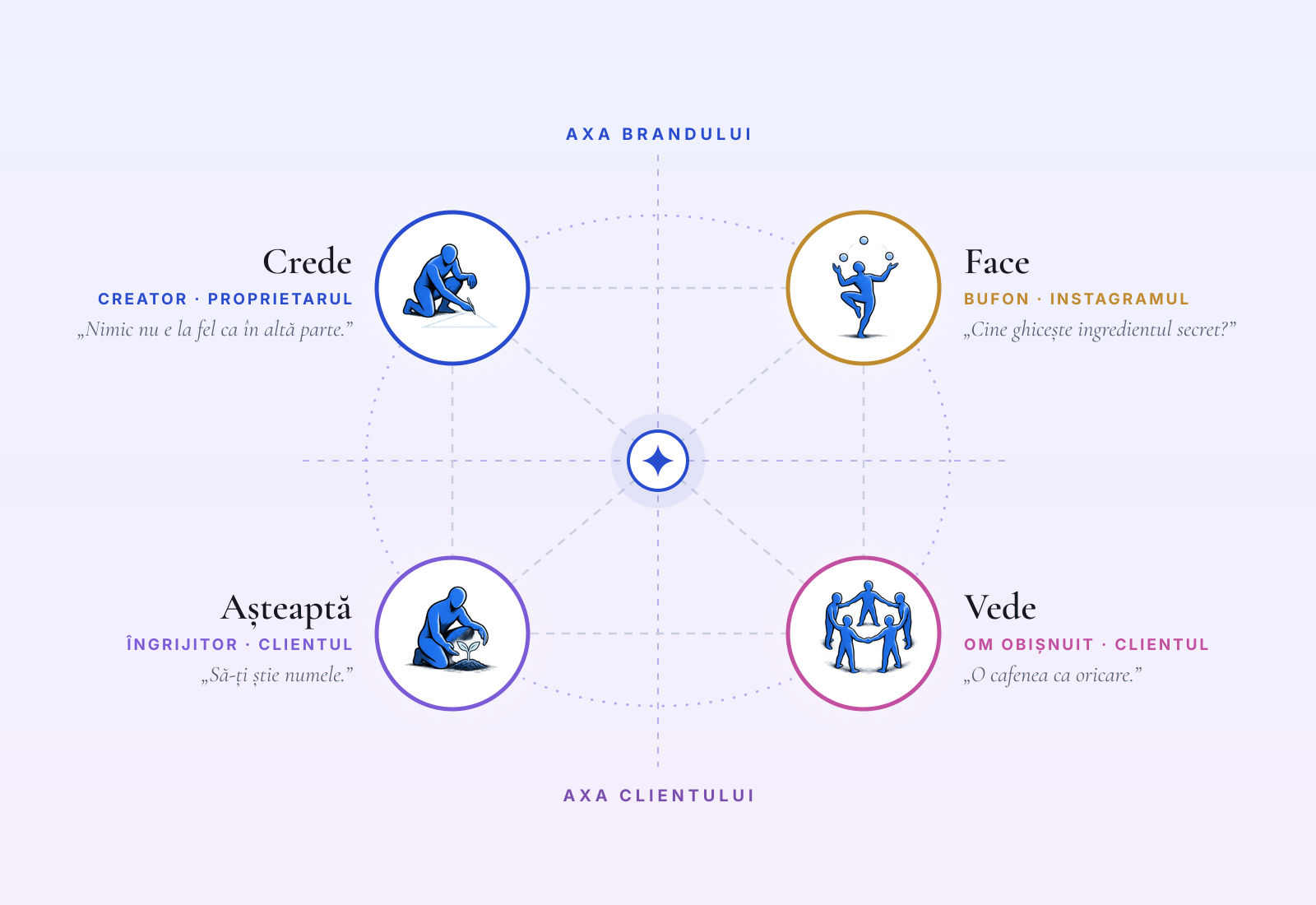
„Four people, four cafés. None of them is wrong: each one saw correctly from where they stand.”
02Why does it matter, if nobody is wrong?
It matters because the four pictures pull the brand in different directions, and the money goes with them. The quality you pay for isn't seen, and the client has no clear reason to come back.
I think about the owner. He pays for good beans and for recipes he worked on through whole nights. But people don't talk about the coffee. They come for the giveaway and leave after the giveaway. And the woman at the next table would be just as happy in the café across the street, if it were two steps closer.
Nobody is to blame here. Everyone does their own part well. It's just that nobody has ever put the four parts side by side, on the same table.
The problem isn't any of the four pictures. It's the distance between them, which nobody sees.
03How does ACM Framework put the four pictures on the same map?
It asks each source with the right instrument and translates all the answers into the same language: a 100-point profile across 12 archetypes. That way, four opinions that couldn't be compared become four profiles you can lay one on top of another.
- Believes: what management believes about the brand
- Does: what the brand publishes on its channels
- Expects: what the client expects from the category
- Sees: how the market sees the brand
This is where the opportunity lies, and it's simpler than it looks. Management answers a short survey of 12 statements, at least three people, so it isn't one person's opinion. What the brand publishes is added channel by channel and coded on the same 12 archetypes. Clients get a public survey: first about what a good café should be like, and only then about yours.
The order of the survey matters. If you mention the brand first, what people expect gets mixed up with what they already see, and you can no longer separate the two.
For the owner, the gain is felt straight away. He no longer guesses what others think. He sees, on the same scale, where the pictures match and where they diverge.
04What does the Does perspective look like on Instagram?
Does is what the brand publishes, so it's the only perspective anyone can see without a survey. On Instagram it shows in what the brand puts at the centre of the frame: the product, the people, the place or the tone.
To show you what this looks like in real life, I did what any curious client does: I opened the Instagram accounts of four cafés in Chisinau and looked. Without measuring anything, just looking, the way you'd look at a shop window.
The posts below are public and are taken from the Instagram accounts named under each image. We show them only as an example, to explain an idea. They are not collaborations, and the rights to them belong to their authors. The archetype under each post is a quick estimate based on a single post: it is not a measurement and not an opinion about the brand.
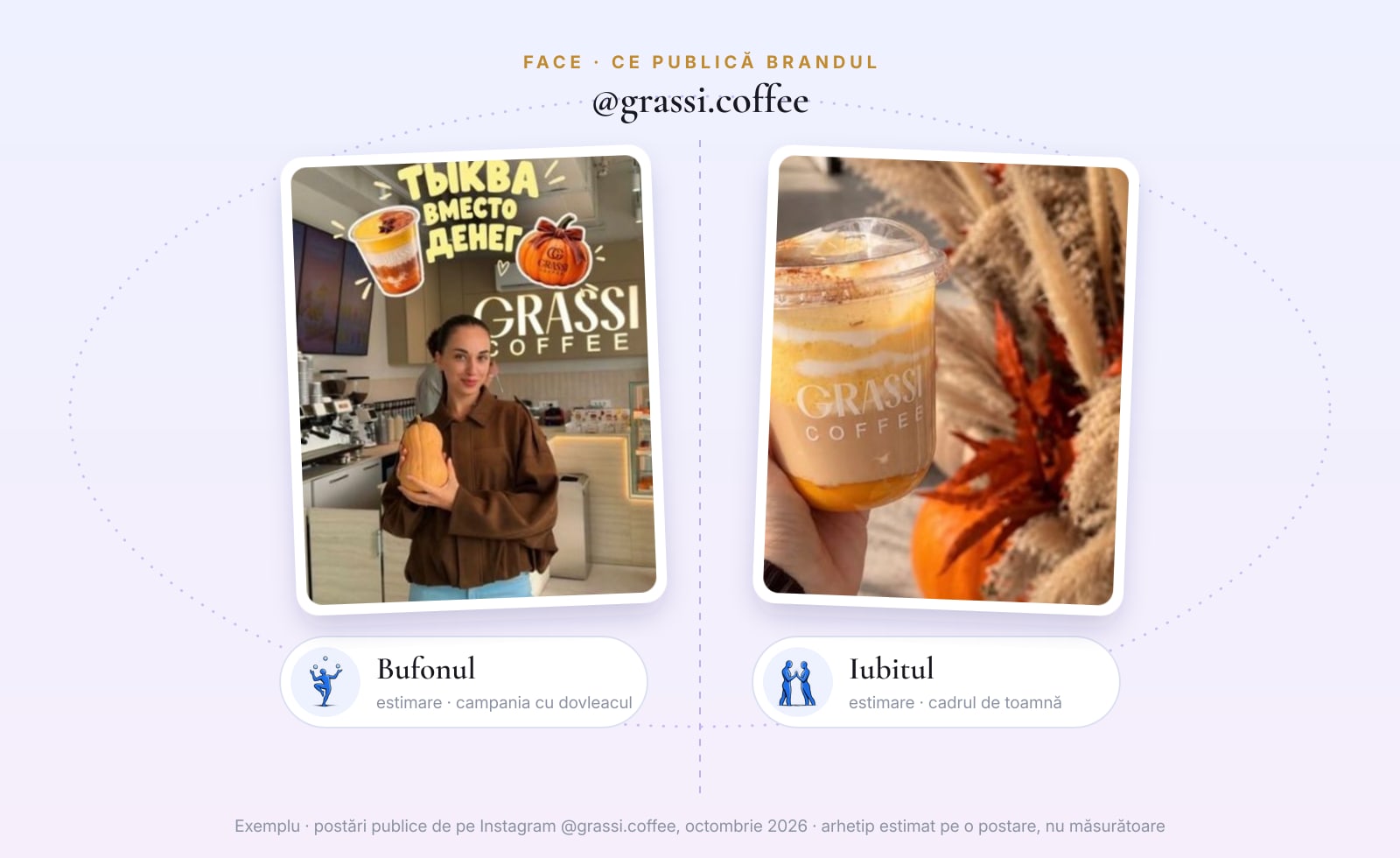
At Grassi Coffee, autumn goes straight into the cup. I see people holding a pumpkin like a trophy and a drink set among dried ears of wheat, like a painting. One moment it makes you laugh, the next it makes you want a taste.
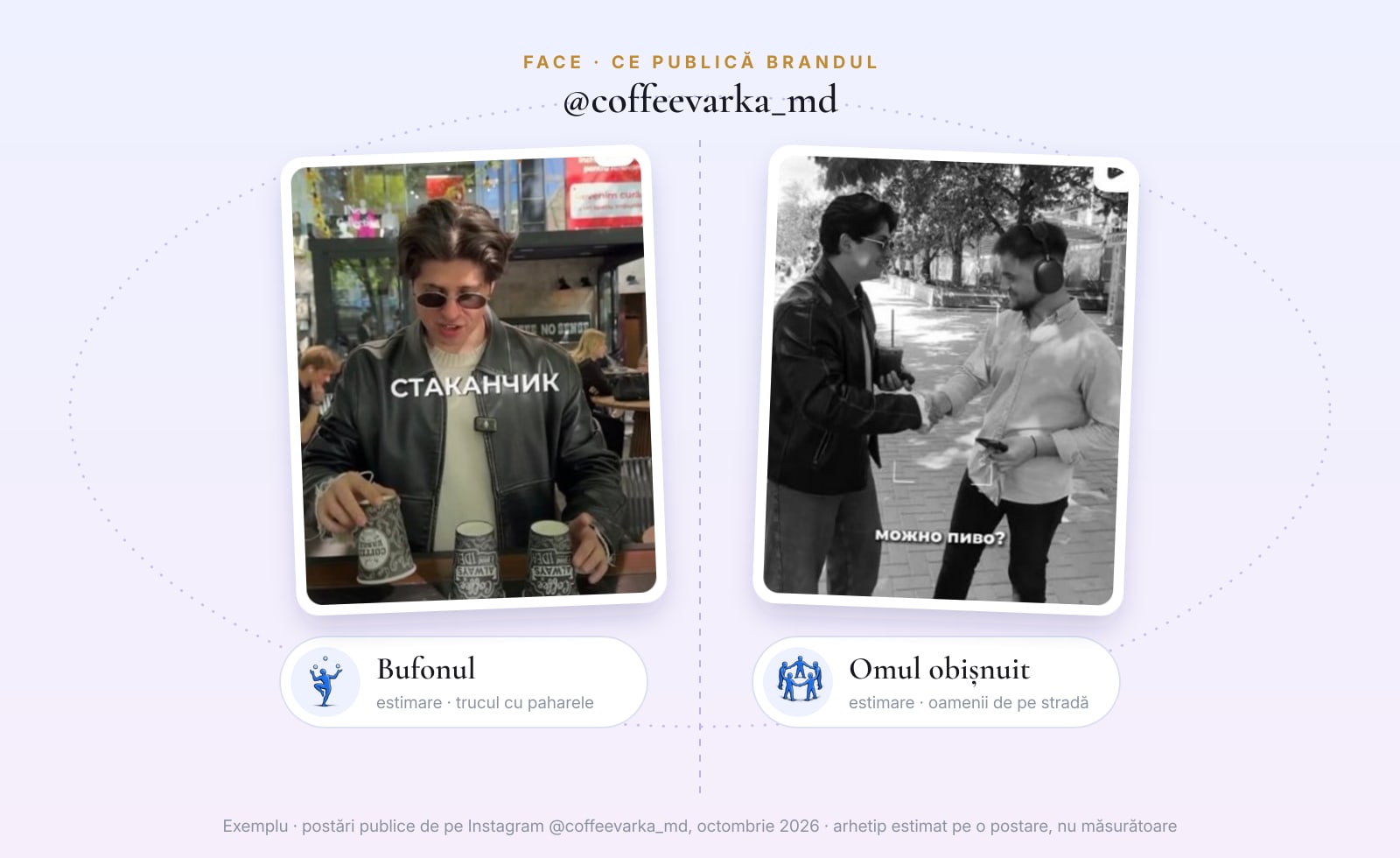
At Coffee Varka, the camera goes out into the street. Passers-by stopped on their way, a question asked on the pavement, a coffee given to someone who didn't expect it. The takeaway cup is in everyone's hand, like an everyday object.
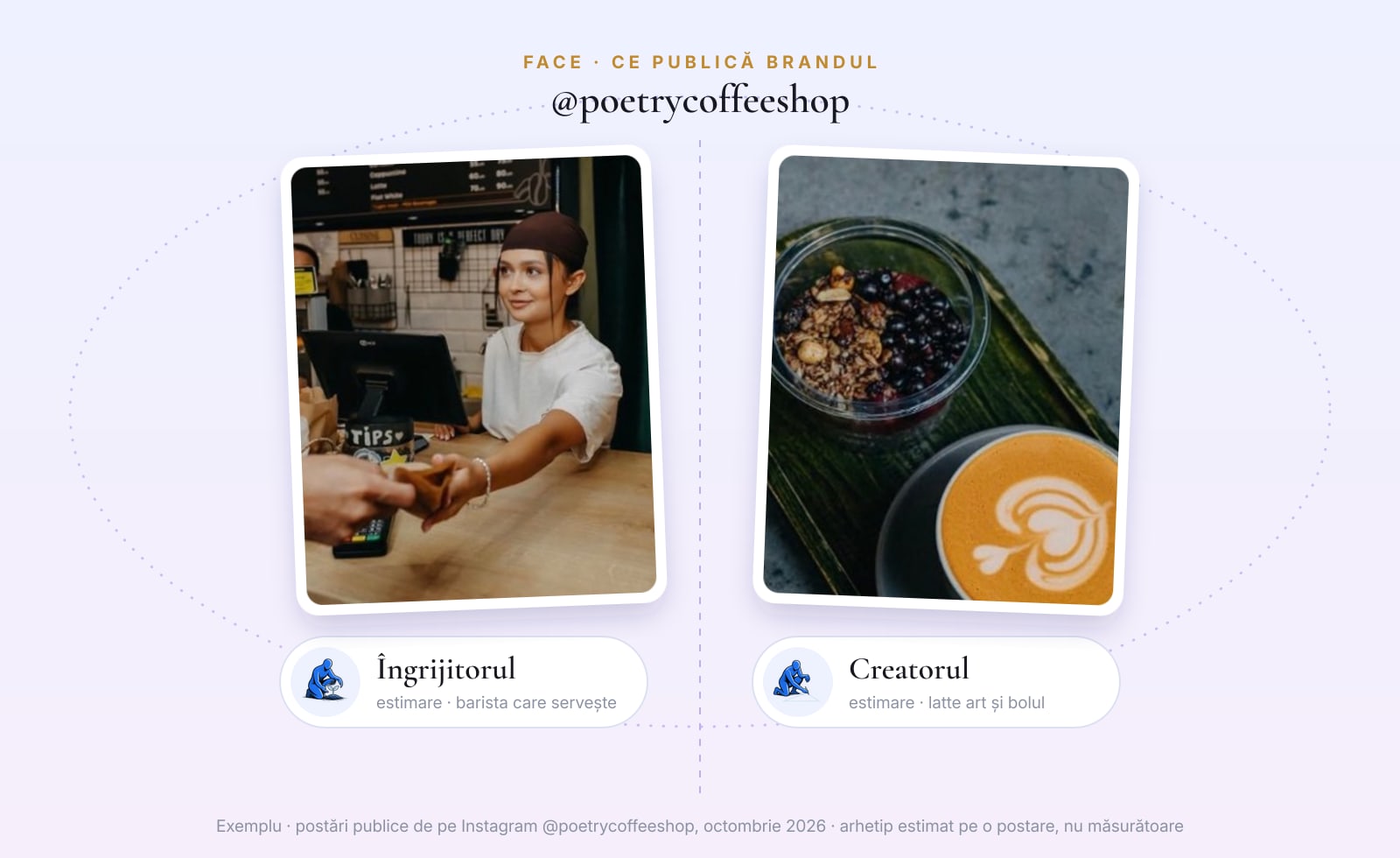
At Poetry Coffeeshop, everything slows down. A barista hands the cup across the counter, the latte art is drawn slowly, and the place seems made for staying. The people who work there appear in the frame as often as the product.
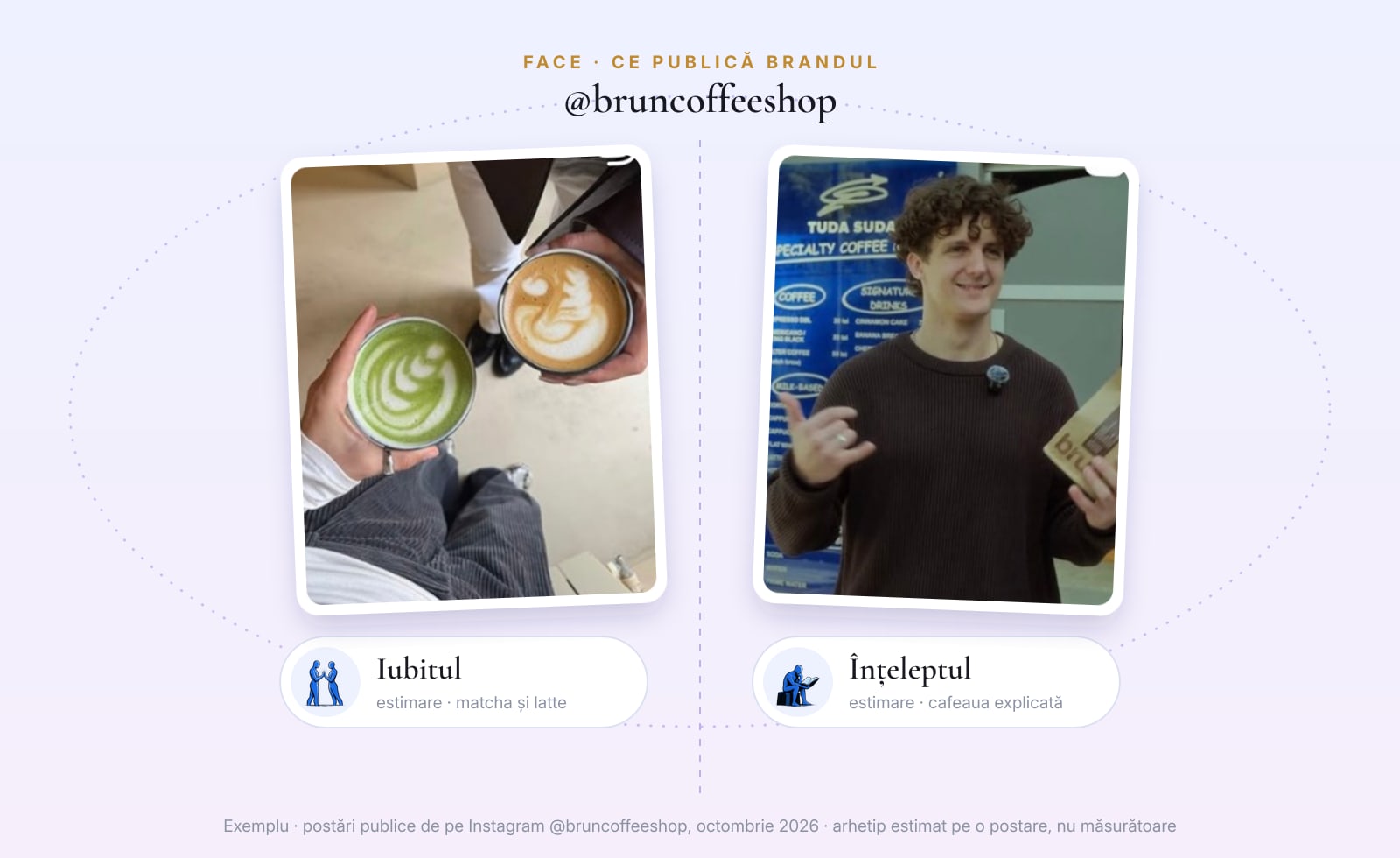
At Brun Coffee Shop, the frame is clean and calm. Matcha and latte seen from above, as in a magazine, and a barista who explains, with his hands, what's in the cup.
Four cafés in the same category and four feeds that look nothing alike. Which one is right? From the feed alone, I can't tell. A feed is right only in relation to what the brand believes about itself and what its clients see.
That's why, in ACM Framework, Does never stands alone. You add the channels where the brand is active, the materials are coded on each channel, and the profile is calculated channel by channel. That way you see which channel speaks in the brand's voice and which has started speaking in another.
05What do the distances between the four show?
They show six distances, one for each pair of perspectives. Four should be as small as possible, and two have an optimal zone where it's good to stay.
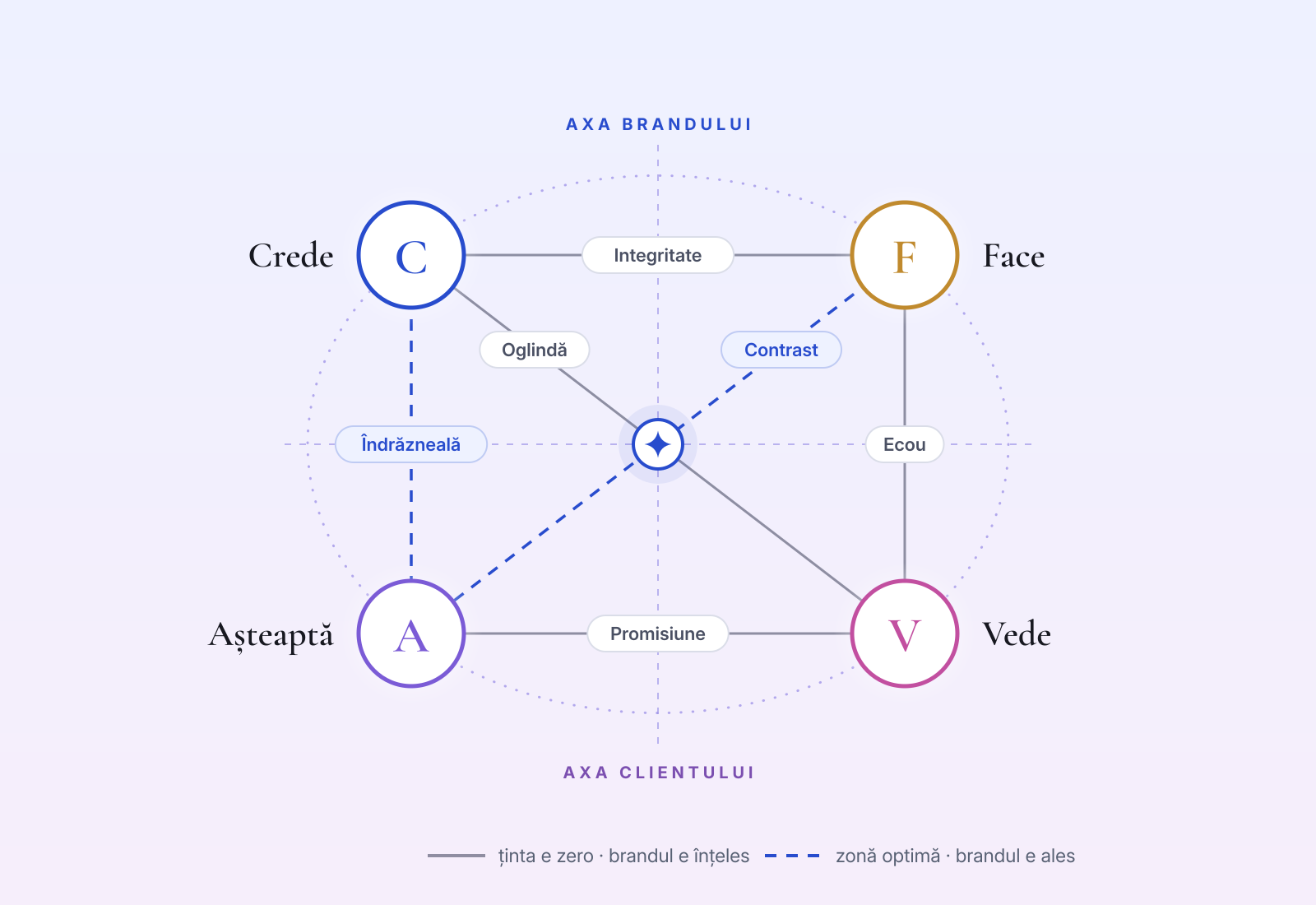
- Integrity, between Believes and Does: does the brand do what it says? The owner talks about craft, Instagram about jokes.
- Legibility, between Does and Sees: is what it does seen? The jokes didn't stay in the client's mind.
- Mirror, between Believes and Sees: is it seen as it believes itself to be? The craft doesn't reach the client.
- Promise, between Expects and Sees: does the client get what they expected? The warmth they're looking for is missing.
- Contrast, between Does and Expects: how differently does it behave? Jokes in a category of warmth.
- Boldness, between Believes and Expects: how different does it want to be? A Creator among Caregivers.
Here's the detail that changes everything: the six distances aren't read the same way. The first four say whether the brand is understood, so any distance is a loss. Contrast and boldness say whether the brand is chosen. A brand identical to its category is correct, but easy to replace.
For the café on the corner, this means something good. The owner wanting a Creator in a category of Caregivers isn't a mistake. It may even be the very thing that makes it irreplaceable. The problem isn't that he wants to be different, but that nobody on the outside sees it yet.
06What do you do with what you've learnt?
You read the diagnosis and choose the first step. For the café in the story, the first step isn't a campaign, but a decision about who the brand is.
In the Command Centre you see everything on one screen: the map, the six gaps with their noise floor and the diagnosis on two axes. When the distances are large almost everywhere, ACM Framework calls the picture Chaotic and tells you plainly that you don't start with communication. For the café on the corner, the order would look like this:
- The owner decides whether the brand really is a Creator.
- The content shows the craft. It can do so with humour too: a brand translates its character on each channel, it doesn't repeat it word for word.
- The experience in the café makes the craft visible to the client.
- Only then comes a campaign, because now there's something to amplify.
Chaotic is just one of five coherence patterns: Aligned, Impostor, Misunderstood, Chaotic and Mixed. Each one says something different about where your money is worth spending, and that's what the next article in the series for brands is about.
07Do you have to measure everything at once?
No. You can start with the internal audit, which uses only what management believes and what the brand publishes, with no public survey at all.
- Internal coherence audit: Believes and Does. It already shows Integrity. Here the café would see the distance between the Creator and the Jester.
- With perception: Sees is added and three gaps appear.
- Full diagnosis: all four perspectives, the six gaps and the diagnosis on two axes.
The simplest thing is to see a full map. The ACM Marketing demo shows a demonstration brand, Nord Atelier, fully measured, and it doesn't need an account.
Tomorrow morning, the café on the corner will open at the usual time. The owner will still believe he makes coffee like nobody else, Instagram will keep joking, the woman by the window will keep waiting for someone who knows her name, and her friend will still find a café like any other. None of them is wrong. It's just that each one sees a different place. When the four views overlap, you have a coherent brand. As long as they don't, that's where the work with ACM Framework begins.
About the examples in this article. The café in the story is imaginary. The cover and the images in the Instagram section use public posts from the accounts @grassi.coffee, @coffeevarka_md, @poetrycoffeeshop and @bruncoffeeshop, shown only as examples, with the source under each image. They are not collaborations and they are not ACM Framework measurements of these brands. The rights to the images belong to their authors. If you own one of these accounts and want an image removed, write to us and we'll take it down.