
Why four gaps are closed and two are calibrated
Four ACM Framework gaps measure whether the brand is understood, and they should be brought as close to zero as possible. Contrast and Boldness measure whether it is chosen, and there you look for an optimal zone: a brand identical to its category is fine, but easy to replace.
Dumitru Talmazan
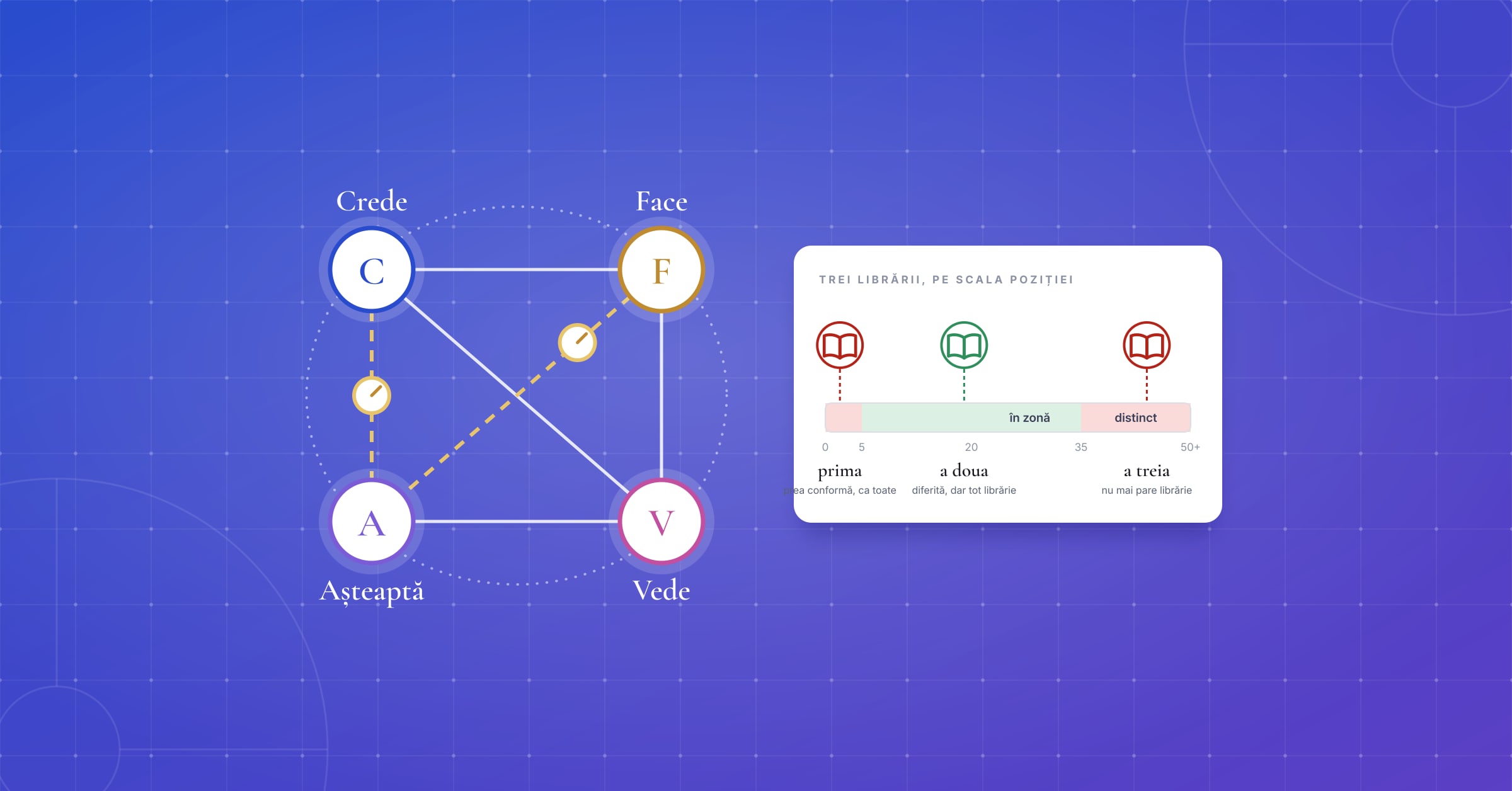
On the street I walk along to work there are three bookshops, a few hundred metres apart. I pass all of them every morning. One day I realised I only ever go into one of them, and that the reason has nothing to do with books.
01Should a brand resemble its category?
Not entirely. Four gaps should be brought as close to zero as possible, but two need some distance, because a brand identical to its category is fine, but easy to replace.
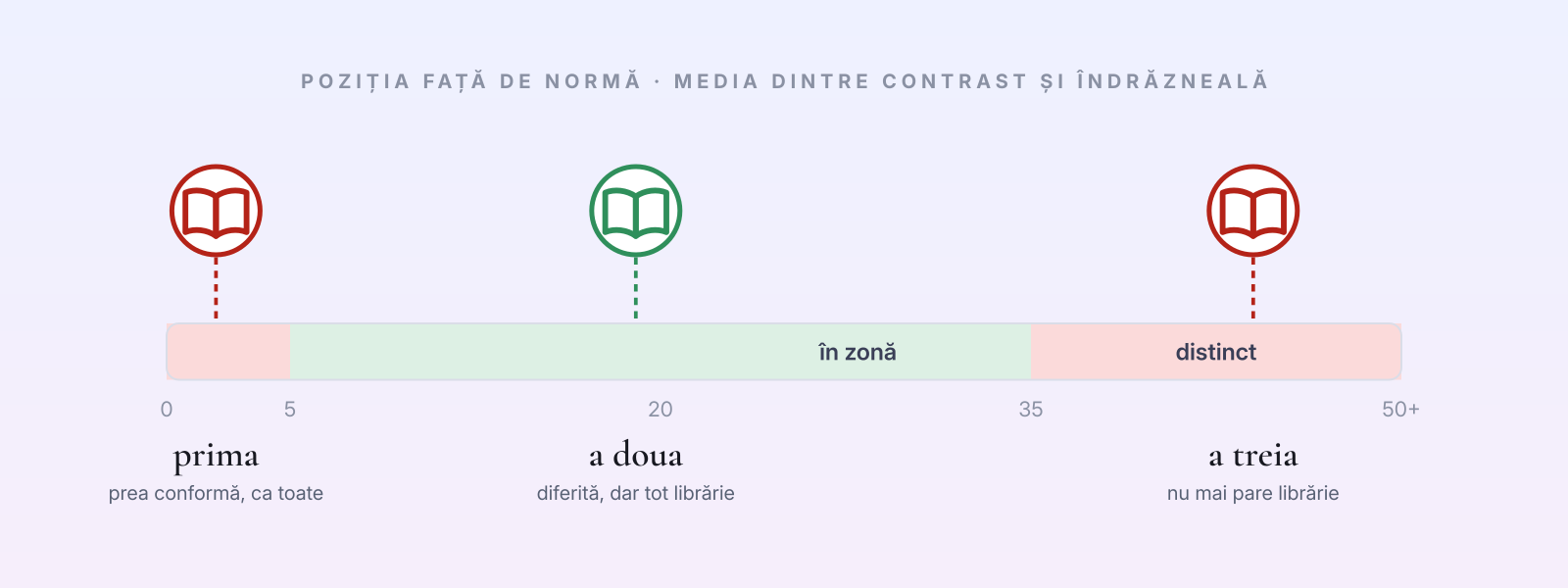
The first bookshop is immaculate. Shelves in alphabetical order, quiet, polite staff, exactly what you picture when you say “a good bookshop”. It gets nothing wrong. And yet people come in, browse, and then order the same book online for two Moldovan lei less. Nothing keeps them there.
The second is a bookshop too, no doubt about it, but it has something all its own. The bookseller hands you a book you weren’t thinking of, and on Thursday evenings someone reads aloud among the shelves. The second one you remember.
The third has gone so far that you no longer know what it is. Board games, cocktails, music, and the books have retreated somewhere to the back. Someone looking for a book doesn’t think of going in there.
„The first bookshop gets nothing wrong. That is exactly why you have no reason to go back.”
02Which gaps should be brought to zero?
Integrity, Legibility, Mirror and Promise. All four measure whether the brand is understood, so any distance there is a loss.
If the bookshop says it is the place for curious readers but its shelves hold only the bestseller list, the Integrity gap grows. If it holds reading evenings but nobody finds out about them, the Legibility gap grows. On these four threads there is no good distance. The shorter they are, the clearer the brand is to anyone who looks at it.
03Which gaps should be calibrated?
Contrast and Boldness. Both measure how far the brand stands from what people expect of the whole category, and there you look for an optimal zone, not zero.
Contrast looks at what the brand does, Boldness at what it wants to be. For both, the instrument puts the optimum at around 20 points, with a tolerance of 15. Below the zone, the brand is too conformist. Above it, it leaves the category.
The alignment that makes you understood should be taken to the maximum. Alignment with the rest of the category should not.
04Why is it a mistake to bring every distance to zero?
Because that is how you end up exactly like the first bookshop: correct and interchangeable. The myth says a coherent brand is a brand that resembles everyone else. The truth is that a coherent brand resembles itself.
I think of a wedding. The dress code for the evening is “formal” and everyone respects it. Whoever turns up in a tracksuit falls out of the picture, and that is not courage, it is carelessness. But whoever comes dressed exactly like the other hundred guests is remembered by no one. The person you remember respected the code and brought something of their own: a colour, a brooch, the way they wear their shirt.
Brands often make this mistake in good faith. They see a distance on the map and close it by reflex, without asking whether it was a distance to close or one to keep.
05How far is too far?
When the brand goes well beyond the optimal zone, people no longer recognise the category and the brand loses its legitimacy. That is the third bookshop: interesting, but no longer chosen for books.
The idea is not new. Research on business strategy has long shown that firms differentiate to escape competition and conform to be credible, and that the best results lie somewhere in the middle. The Archetypal Coherence Matrix (ACM Framework) takes the same shape to the level of brand character and makes it measurable.
One thing, said honestly: the threshold of 20 is declared provisional, like the weights. It will be estimated from data, relative to how spread out each category is, because in a category where everyone looks alike, 20 points is a lot, and in a varied one it is little.
06What does this look like on the platform?
Like a two-word diagnosis. The first word says how coherent the brand is with itself, from Integrity, Legibility and Mirror. The second says where it stands relative to the norm, from the average of Contrast and Boldness: “too conform”, “in zone” or “distinct”.
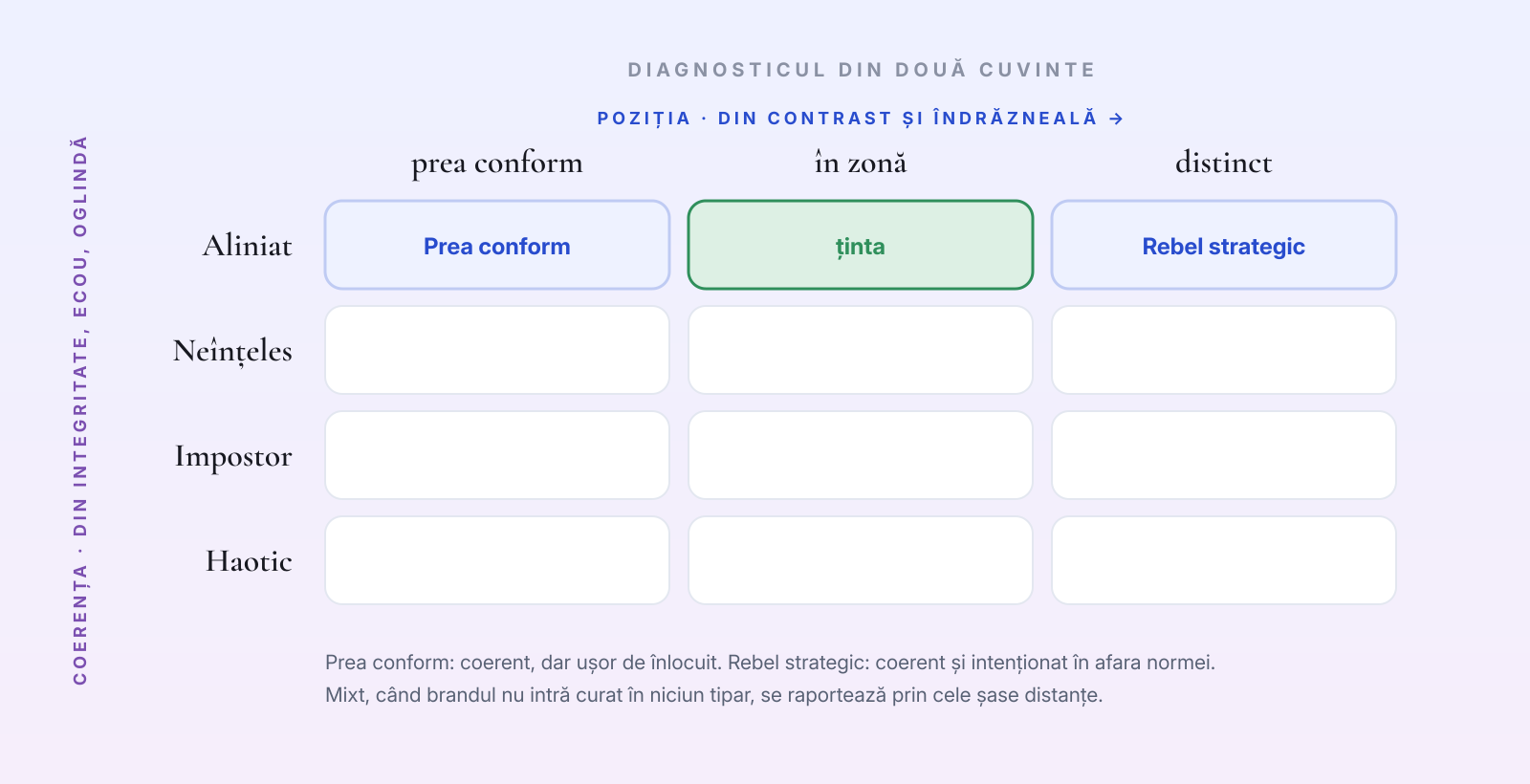
Two combinations have names of their own. “Too conform” is the brand that is coherent but has nothing to set it apart: the first bookshop. “Strategic rebel” is the brand that is coherent with itself and deliberately outside the norm. That is not chaos, it is a choice, and the instrument only asks you whether the departure is intended. If it is, it leaves it alone.
The benefit is that you no longer confuse two different problems. A brand that isn’t understood needs clarity. A brand that is understood but isn’t chosen needs courage.
07What do you do if you are too conformist?
You choose one single thing in which to be different, one that comes from what management believes, and you make it visible everywhere. You don’t invent a new personality; you bring forward a part of the one you already have.
- Look at Believes: what management says sets you apart, even if today it doesn’t show.
- Choose one single thing, not five. For the first bookshop, it could be the bookseller’s personal recommendation.
- Move it into Does: on the shelves, in the window, on every channel.
- Measure again and watch two threads: Contrast should move into the zone, Integrity should stay small.
The order matters. If you start with difference before you are understood, you become the third bookshop. If you stop at clarity, you stay the first.
The next day I walked past the first bookshop again. The window was just as clean, the shelves just as tidy. I didn’t go in this time either. Only then did I put into words what was keeping me outside: it had done nothing wrong, but it hadn’t given me any reason to open the door.
About the example in this article. The three bookshops are imaginary. The optimal zone, the tolerance, the axes of the diagnosis and the “Too conform” and “Strategic rebel” combinations come from the published ACM Framework instrument, where the thresholds are declared provisional.