Repromed, the first brand measured by group SMK260
Group SMK260 at USM begins a semester of brand audit at the Repromed Hospital with the ACM Framework method: four perspectives, six distances and a baseline snapshot the hospital can carry on by itself.
Grupa SMK260, Universitatea de Stat din Moldova
Over 42,000 consultations, 6,000 surgical procedures and 1,000 births in a single year. The figures say how much a hospital works. They do not say whether the hospital is seen by its patients the way it sees itself. That is where our project begins.
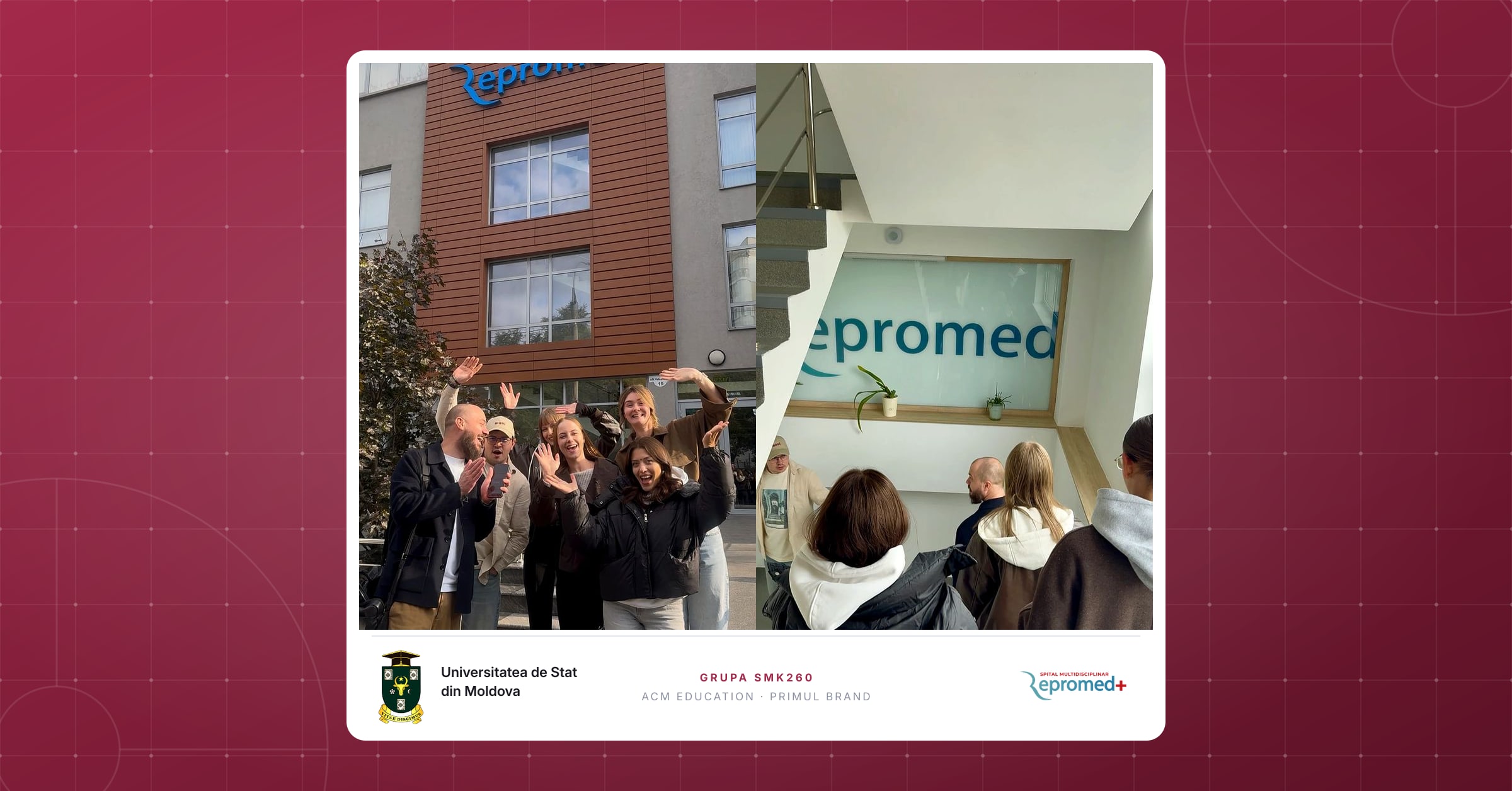
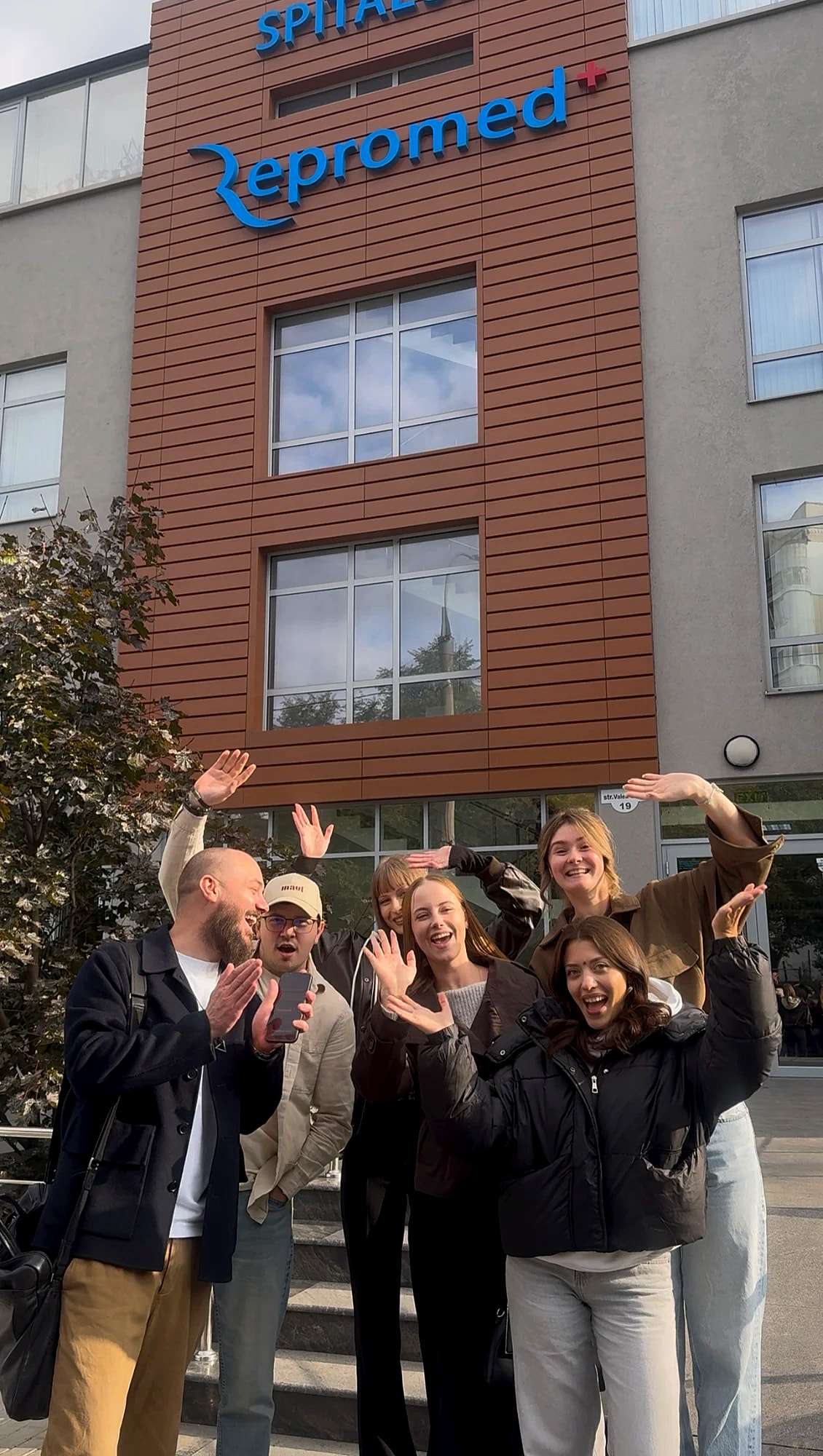
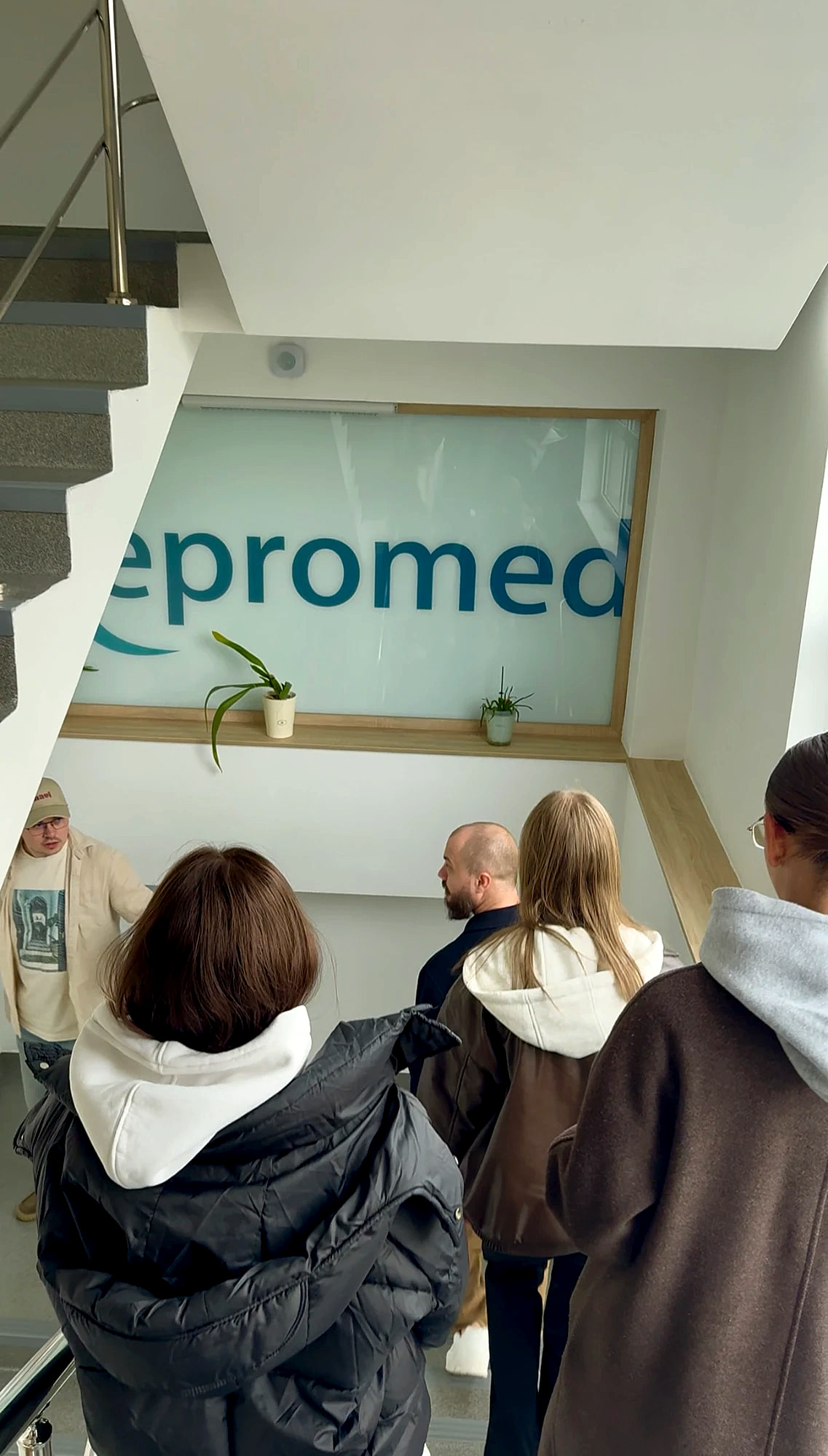
The master's students of group SMK260 at Moldova State University (USM) visited the Repromed Multidisciplinary Hospital in Chișinău. It was not a field trip: it was the first meeting of a semester-long collaboration in which the group will measure the Repromed brand with the ACM Framework method, together with the hospital's marketing director and the lecturer of the course. This article tells what we saw and what comes next.
01How does a brand audit begin in a hospital?
With people and materials, not with a conclusion. A brand audit in a hospital begins with a meeting with those who lead and communicate the hospital, with the list of channels the hospital publishes on, and with the questions for patients: what they expect from a good hospital and how they see this one. At Repromed, the first meeting was the group's visit; next come the leadership survey, then the coding of materials and the public survey.
02What do the Repromed figures say?
That it is a young hospital with a large volume of activity: opened in 2019, with over 42,000 consultations, 6,000 procedures and 1,000 births in 2025. The figures show what the hospital does; what we will measure is how it is perceived.
According to the data published by the institution, around 7,000 imaging investigations were also carried out in 2025. The hospital has 60 beds, 10 of them in intensive care, three operating theatres and three delivery rooms. For marketing, figures like these are good material: they show the institution's experience and support its credibility. But the difference between what a hospital does and how it is seen is exactly the place where our work begins.

03What did the Repromed specialists tell us?
That in medicine you can attract attention through advertising, but trust is earned through real experiences. We heard this from a doctor and from a marketing professional, each from their own chair.
The most valuable moment of the visit was meeting Dr Elena Parpaut, obstetrician-gynaecologist, and Mircea Covalschi, marketing specialist. They described the same hospital from two different places: the doctor, through professionalism, empathy and the relationship of trust with the patient; marketing, through the way these values reach, or fail to reach, the public outside. A medical brand is built from every point of contact with the patient, from the website and the reception desk to the way a doctor speaks.

04What will we measure at Repromed?
Four images of the same hospital, on the same 12 archetypes: what leadership believes, what the hospital publishes, what patients expect from a good hospital and how they see Repromed. We call them the four perspectives of a brand. Between them, six distances are calculated.
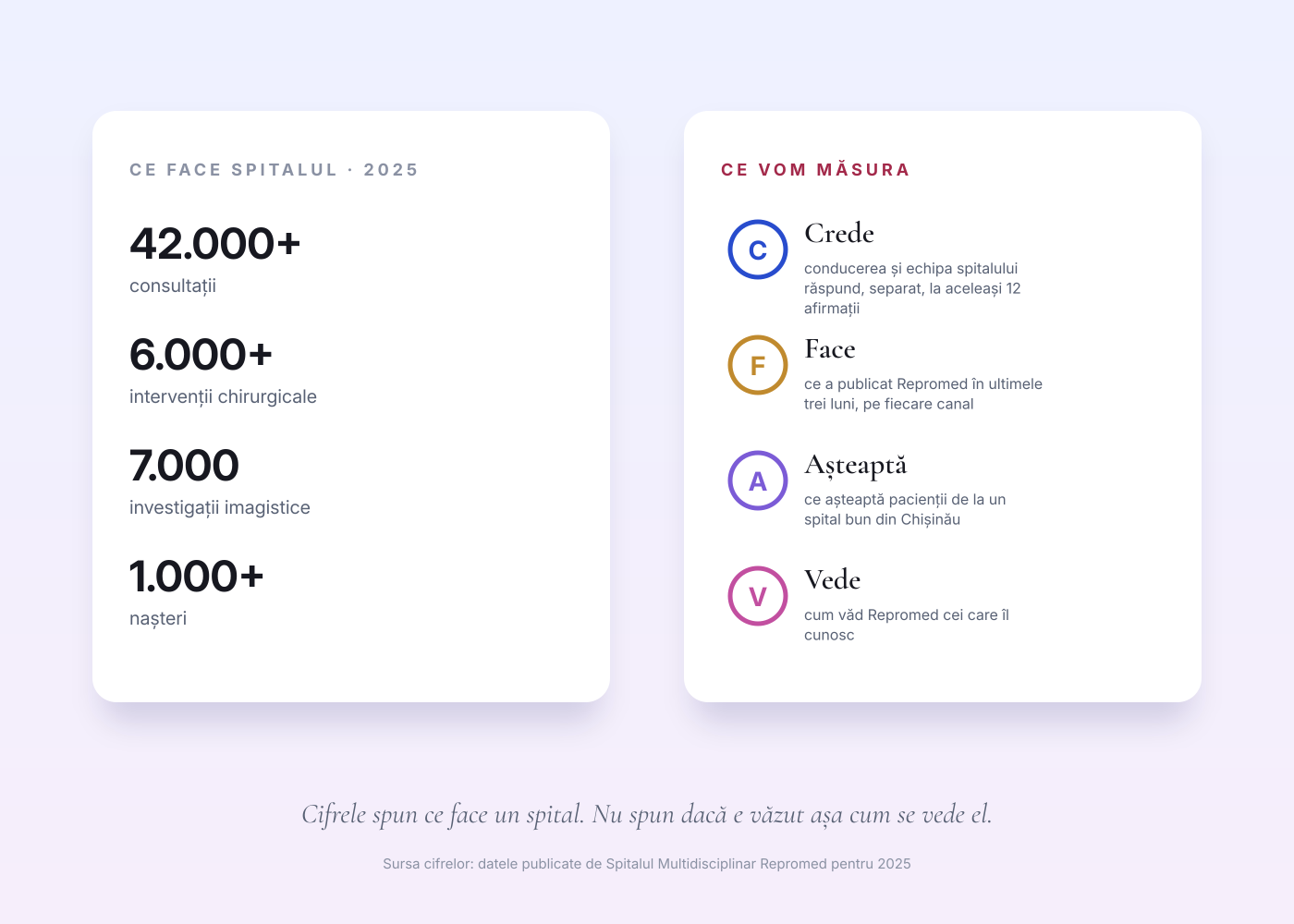
- Believes: the hospital's leadership and team answer, each separately, the same 12 statements about the brand. We see whether the people inside describe the same Repromed and what their shared profile is.
- Does: we code what Repromed has published in the past three months, channel by channel. We learn what brand emerges from what the hospital publishes, not from what it intends.
- Expects: we ask patients and potential patients what they expect from a good hospital in Chișinău, before we mention any name.
- Sees: those who know Repromed we then ask how they see it.
The six distances show whether what the hospital believes makes it into what it publishes, whether what it publishes reaches the patient, and whether the patient receives what they expected from a hospital. None of this is a good or a bad mark: it is a snapshot, with figures anyone can check.
05Who does what in group SMK260?
The group works as a team with roles: one coordinator, two coders and the rest of the team on materials and the survey. The hospital's marketing director opens access to the channels, and the lecturer leads the group and checks the coding.
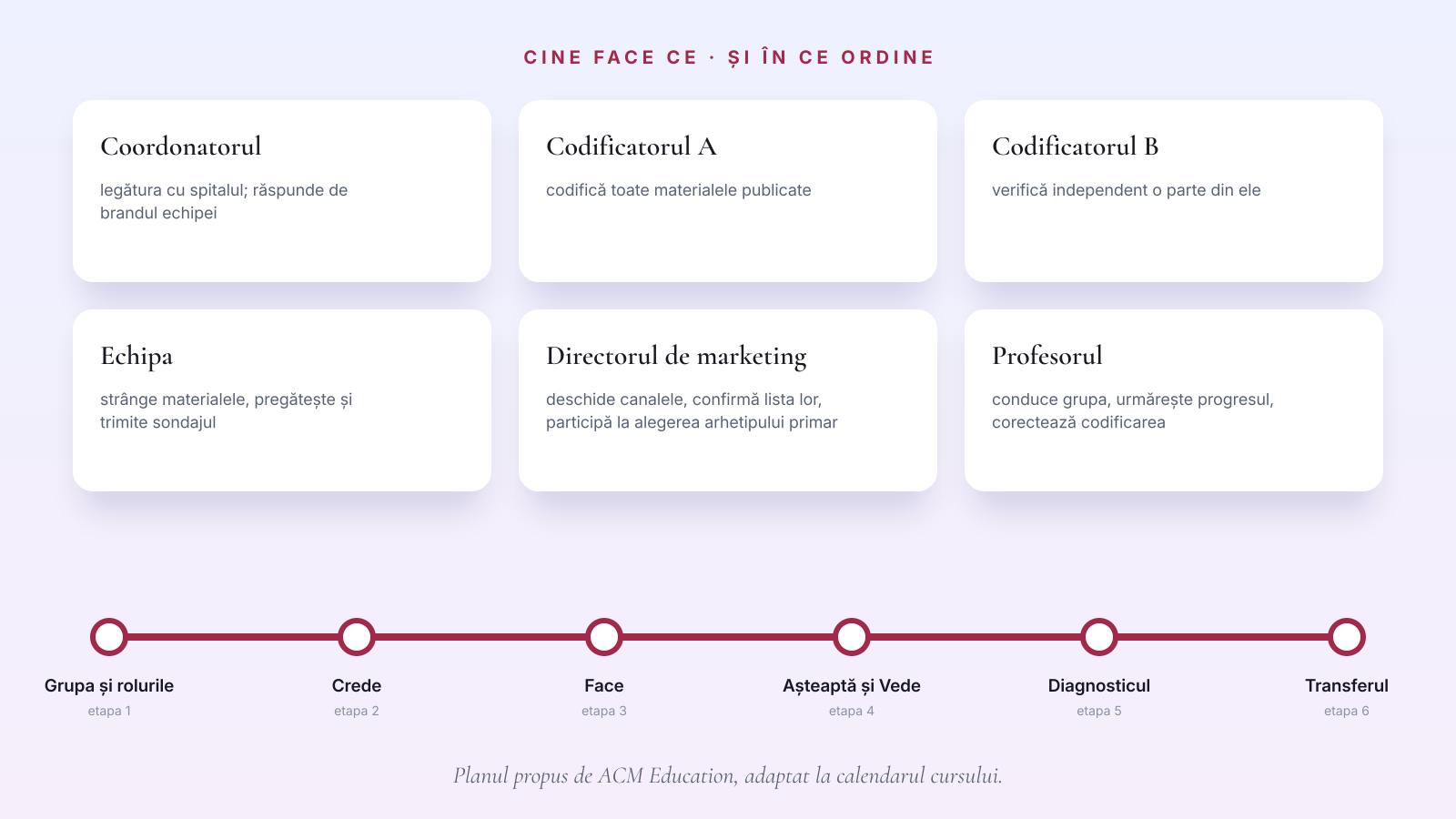
The Coordinator keeps in touch with the hospital and is responsible for the team's brand. The first coder reads all the published materials; the second independently checks a share of them, so that the result does not depend on a single person. The rest of the team gathers the materials, prepares and sends the survey. The marketing director confirms the list of channels and takes part in the meeting where leadership chooses its primary archetype. The lecturer follows progress on each perspective and corrects the coding where the two coders disagree.
06What does Repromed get at the end?
The brand's baseline snapshot: the four profiles, the six distances and a diagnosis read by the group in front of leadership, with recommendations. Then the hospital can take over the measured brand in ACM Marketing and carry on by itself.
It is not a report left in a drawer. With the brand transferred, Repromed can re-measure a few months later, to see whether what it changed has taken hold. For us, the students, it is the first time we work on a real brand, with a method professionals use too, and the first time the result of our work stays with someone. In the same semester, the group is also measuring the brand of its own university, USM.

07Why does the lesson only begin now?
Because at Repromed we saw a hospital that communicates its results and presents its people, and what we will measure over the coming months is whether that image, the one from inside, is also the image its patients hold.
What the measurement will not say: it does not assess the quality of medical care and does not replace the hospital's clinical indicators. It only says whether the image Repromed has of itself, the one it publishes and the one patients hold describe the same hospital.
How long does a hospital brand audit with a group of master's students take?
One semester. The visit opens the project; then come the leadership survey, the coding of published materials and the public survey, and at the end the group presents the brand's baseline snapshot.
Are patients' medical data used?
No. The public survey asks about expectations and about the hospital's image, on the same 12 archetypes; it does not ask for diagnoses, treatments or any other medical data.
Can another hospital or clinic run the same audit?
Yes, with a student group in ACM Education or directly in ACM Marketing. The conditions are the same: leaders who answer, channels with materials and patients who know the institution. To see how it works, try the demo.
The first stop was the visit. The next is the leadership survey. We will be back with the baseline snapshot of the Repromed brand at the end of the semester.
About the method. The Archetypal Coherence Matrix (ACM Framework) is a brand audit framework created by Dumitru Talmazan, which measures a brand's coherence on four perspectives, what leadership believes, what the brand publishes, what the customer expects from the category and what the customer sees, all on the same 12 archetypes, and calculates six distances between them. The instrument is published openly on Zenodo (DOI 10.5281/zenodo.22926708), and the verification benchmarks were registered on OSF before data collection (DOI 10.17605/OSF.IO/6NDRB). The group's project takes place in ACM Education.
Source of the figures: data published by the Repromed Multidisciplinary Hospital for the year 2025. The names and photographs of the specialists and the students appear with their consent.