
Coherent doesn't mean the same: a brand on 20 channels
A brand that is coherent across all its channels has the same character, expressed in each channel's language, not the same post everywhere. ACM Framework gives each channel a profile and a status, so you can see where the brand speaks in its own voice and where it has started speaking in another.
Dumitru Talmazan
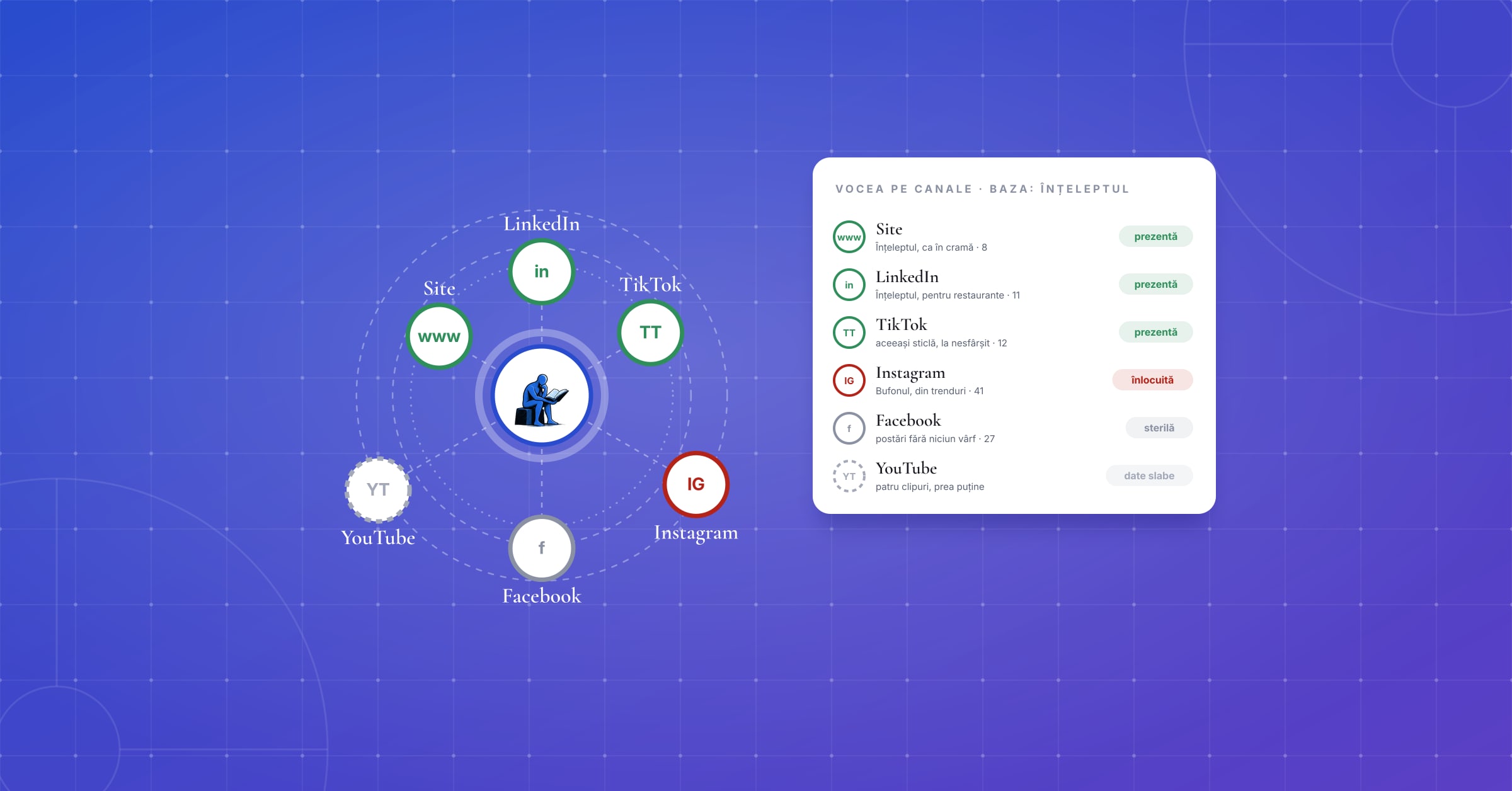
On the edge of a village there's a family winery, with old barrels and a winemaker who talks about grapes the way other people talk about their children. The winery is on six channels. I opened them one by one and felt as if I'd stumbled on six different wineries.
01What does it mean for a brand to be coherent across all channels?
It means the same character, expressed in each channel's language. Not the same post everywhere, but the same person speaking differently in different rooms.
My grandmother had a single story about the winter when the snow reached the eaves. To her five-year-old grandson she told it with sounds and with her hands, so he could see the snow. To the neighbour she told it with names and years. At the holiday table, with a joke at the end. It was the same woman and the same story. Only the room was different.
That's coherence across channels. If my grandmother had told the story the same way everywhere, the child would have fallen asleep. If she'd become someone else at every table, nobody would have known who she was any more.
02What happens when you publish the same thing everywhere?
The channels start to go quiet. The message reaches people in different states of mind and fits none of them.
At the winery, someone decided at some point that it was simpler this way: the same photo of the bottle on the barrel, the same phrase, “quality wine since 1998”, on the website, on LinkedIn, on TikTok. On the website it works. On LinkedIn, restaurant owners scroll past, because they learn nothing new. On TikTok, nobody stops at the twentieth photo of the same bottle. The voice is there, but the channel isn't being used.
03What happens when each channel speaks differently?
The brand falls apart. On one channel it ends up speaking in a voice that is no longer its own, and the people who find it there no longer recognise it anywhere else.
The winery's Instagram was handed to an agency, which followed the trends: memes, challenges, fashionable music. The posts caught on, but on Instagram the winery became a Jester. Whoever then comes to a tasting, expecting the party from their phone, finds a quiet man explaining why the grapes were picked at night. It's not a big disappointment, but it is a break.
Being coherent doesn't mean being the same. It means staying the same person, whichever room you walk into.
04How does the Archetypal Coherence Matrix (ACM Framework) see the brand's voice on each channel?
Each piece of material is coded on the 12 archetypes, and each channel gets its own profile, from at least ten pieces of material. The platform then places it next to the brand's base and gives it a status.
The coding is done on four components of each piece: the message, the text, the visuals, and the sound and movement. That's why, when a channel drifts, the platform also tells you which part the drift comes from, and you know who to talk to: whoever writes, whoever designs or whoever films.
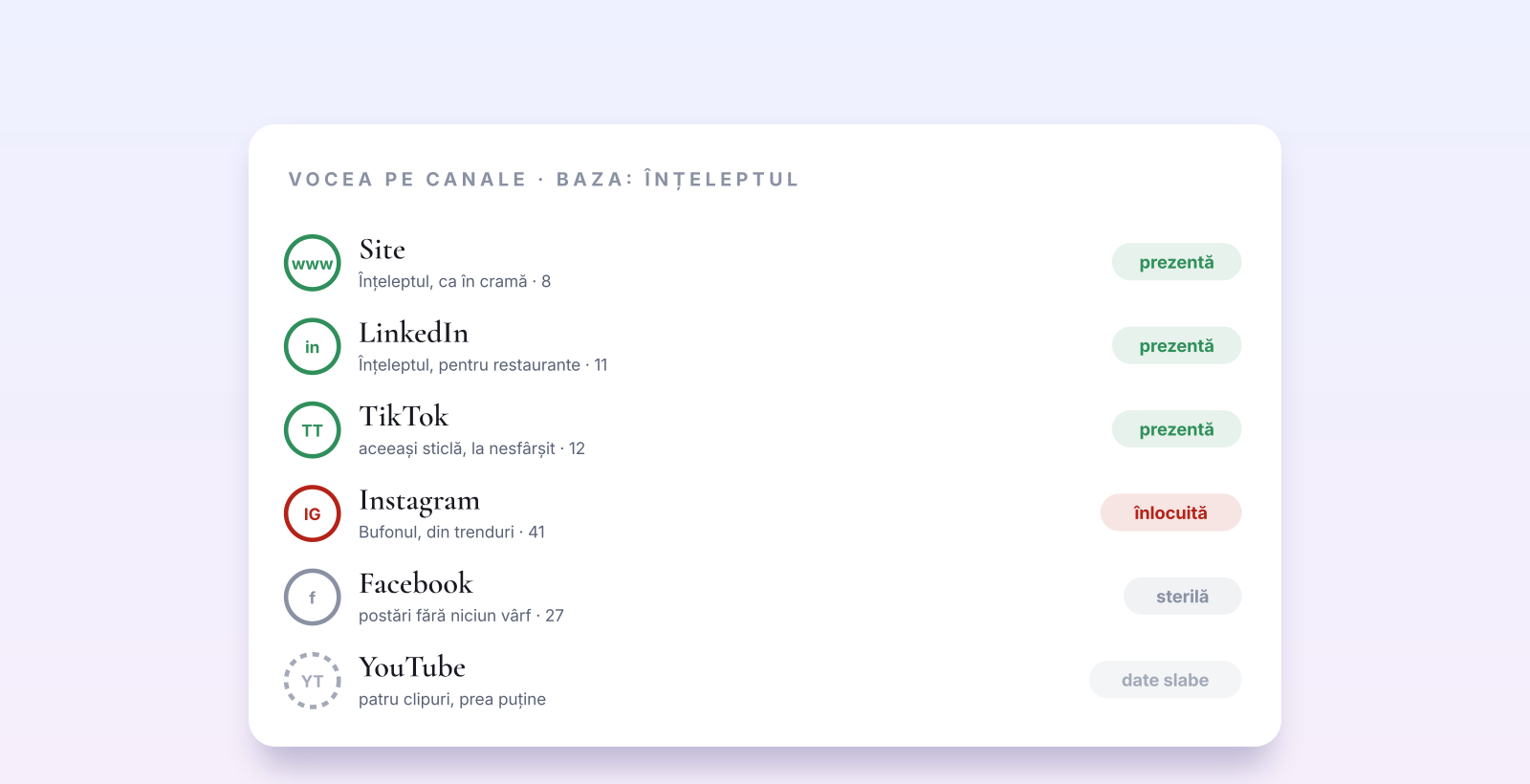
- Present: the channel speaks in the base voice.
- Deviated: the voice is still from the brand's family, but another archetype has moved to the front.
- Replaced: the channel speaks in a voice that isn't the brand's.
- Absent: the base archetype has almost disappeared from the channel.
- Sterile: the materials have no peak, they say nothing in particular.
- Deliberate adaptation: the channel speaks differently, but that's what you decided.
- Weak data: too few materials to say anything with confidence.
05What does the channel matrix show?
It asks each channel two questions: is it close to the base voice, and does it follow the way people talk on that channel? The two answers give four situations.
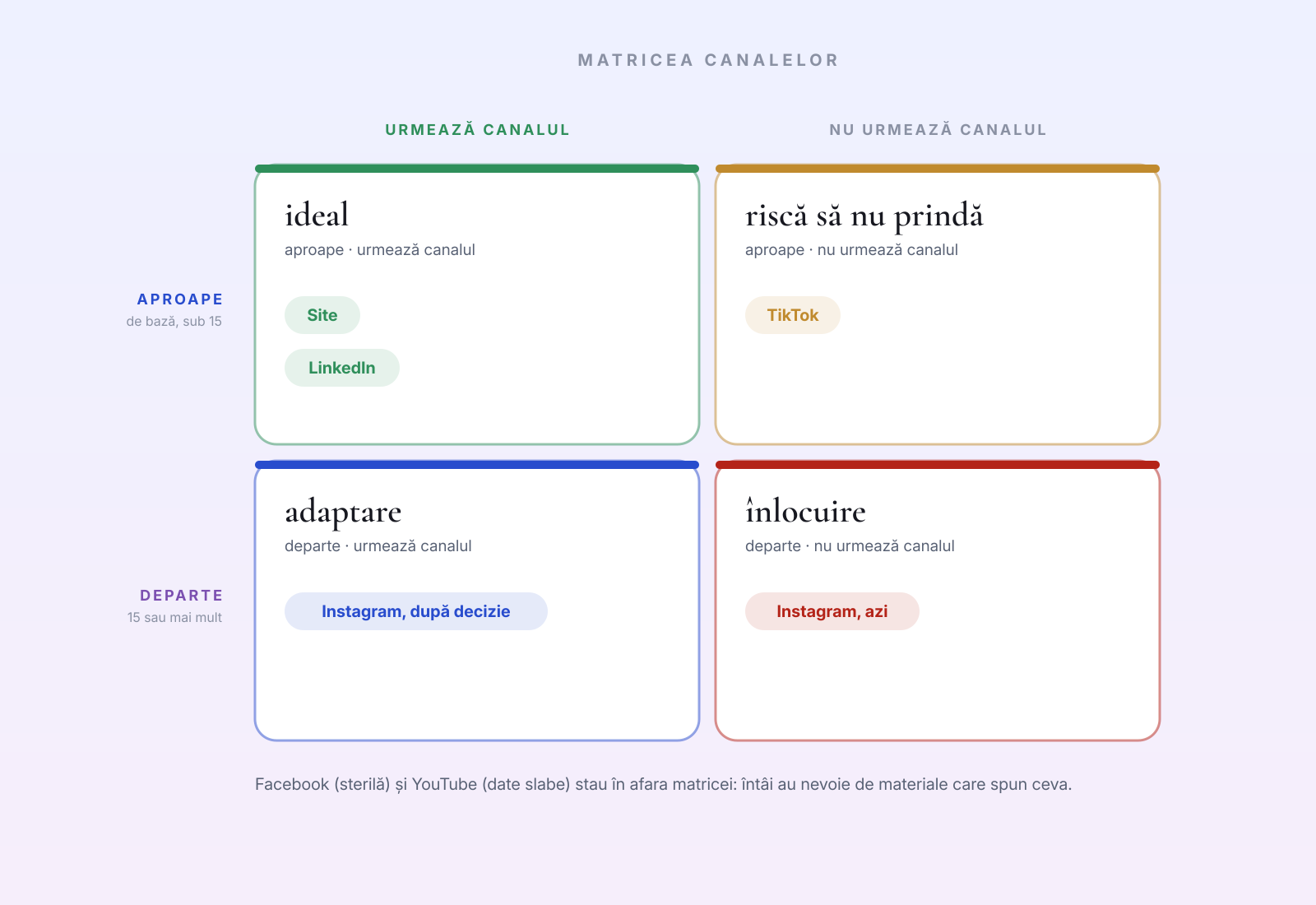
The winery's website and LinkedIn are in the ideal corner. TikTok is close to the base but doesn't use the channel, so it risks not catching on: the same bottle, over and over. Instagram is far away and in a different voice, so it's a replacement. Facebook and YouTube stay outside the matrix for now, because first they need materials that say something.
06What do you do with a channel that has drifted?
You decide, in writing, one of two things: you correct it, or you declare it a deliberate adaptation. The decision is kept with its date, and when you measure again you see whether it worked.
At the winery, the discussion was short and honest. On TikTok, they decided to correct course: the winemaker films 30 seconds at a time in the winery, at night, during the harvest, explaining one single thing. It's still the Sage, only now it speaks the channel's language. On Instagram, they decided that part of the personality there was worth keeping, but not the Jester. They chose the Lover, the pleasure of the senses, the colour of wine in the glass, and declared it a deliberate adaptation.
The difference between a drift and an adaptation isn't in the numbers. It's in the fact that you chose it with your eyes open. The platform remembers the choice and no longer reports it as a problem.
07How do you measure coherence across all channels at once?
Through dispersion: the average distance between all pairs of channels. The smaller it is, the more the channels resemble each other, around the same fingerprint.
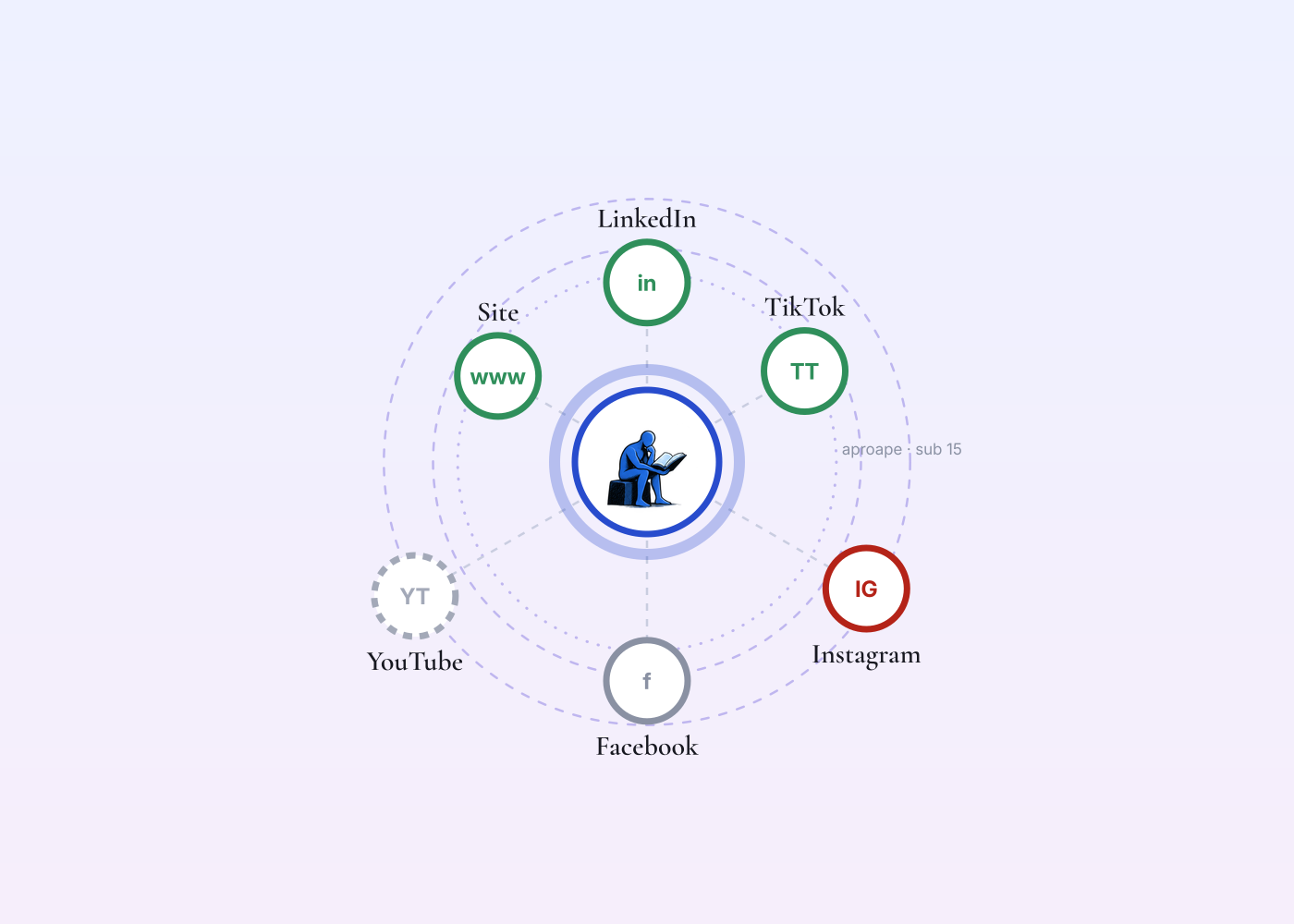
It's the part I like most in the whole method, because it's measured only from what the brand has published. You don't need a single respondent or any survey. A brand that wants to find out whether it speaks with one voice can find out from the content it already has.
- You add the channels where the brand is active.
- You add at least ten materials per channel and code them, ideally with two coders.
- You read the voice status on each channel and the matrix.
- You decide on the channels that have drifted: correct them or declare a deliberate adaptation.
- You measure again and watch the channels gather around the fingerprint.
My grandmother never changed her story about the snow up to the eaves. She only changed the way she told it, depending on who was listening. That's what the winery is missing: not the same post everywhere, but the same character. A test anyone can do: cover the logo and ask yourself whether you'd guess it's the same brand. If yes, it has one voice. If not, it has six.
About the example in this article. The winery and its channels are imaginary, as is the grandmother in the story. The voice statuses, the minimum of ten materials, the channel matrix and dispersion come from the published ACM Framework instrument and the platform's rules.