Archetypes are not a horoscope: what ACM Framework takes from Jung
Archetypes are a vocabulary, not a law of nature, and ACM Framework uses them as a ruler, not as a foundation. What makes the measurement serious is the rules: rated statements, independent coders and thresholds that stop a number before it reaches the report.
Dumitru Talmazan
Sunday lunch with the family. Between the soup and the roast, my aunt reads the horoscope from her phone, out loud, for each of us. My cousin, who works in marketing, laughs and says: “Brand archetypes are pretty much the same thing, just for companies.” The table laughs. I don’t, and I tried to explain why, between two courses.
01Are brand archetypes scientific?
Archetypes in themselves are a vocabulary, not a law of nature. What can be scientific is the way you measure them, and the Archetypal Coherence Matrix (ACM Framework) turns them into measurements that anyone can check.
It is a small distinction, but it changes everything. Nobody asks whether the metre is scientific. We ask whether someone measured correctly with it. Same here: the right question is not whether there are twelve archetypes, but whether a brand’s profile was measured honestly.
02How is it different from a horoscope?
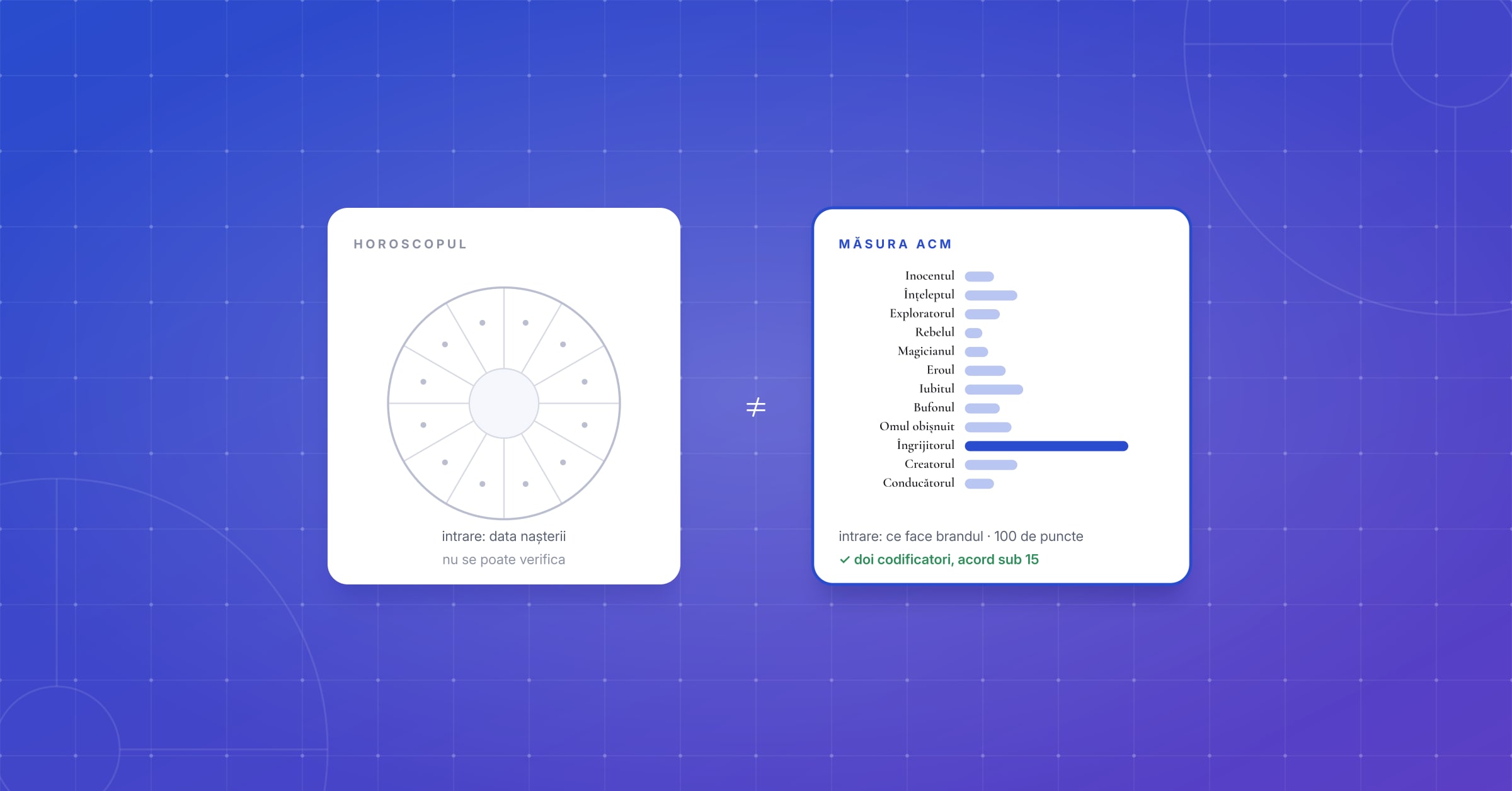
A horoscope starts from your date of birth and cannot be checked. ACM Framework starts from what the brand does and has rules that say in advance when a number is not reported.
I told my cousin that his horoscope would have been the same whether he were the most hard-working man in town or the laziest. Your date of birth doesn’t change. A brand’s profile, on the other hand, changes precisely according to what it does: what it publishes, how it speaks, what the people who run it believe and what customers see.
A horoscope cannot be wrong, because it says nothing that can be checked. An ACM Framework measurement can be wrong, and that is exactly why it has rules that stop it.
03What does ACM Framework take from Jung?
Only the origin of the vocabulary. Jung described patterns that recur in dreams, myths and stories, such as the Hero or the Wise Old Man, but he never made a list of twelve and never said how many there are.
The list of twelve comes later, from Carol Pearson, and Margaret Mark and Carol Pearson took it into marketing in 2001. Their book describes the archetypes but contains no measurement instrument. The statements and rules of ACM Framework were written from scratch, based on the definitions in the book.
What ACM Framework does not take from Jung is the collective unconscious. We don’t use it as an explanation and we don’t try to prove that humanity shares a common store. We measure brand profiles. That’s all.
04Why exactly twelve archetypes?
Because a fixed list is needed so that profiles can be compared. Twelve is the list used in branding research, and ACM Framework uses it as a ruler, not as a foundation.
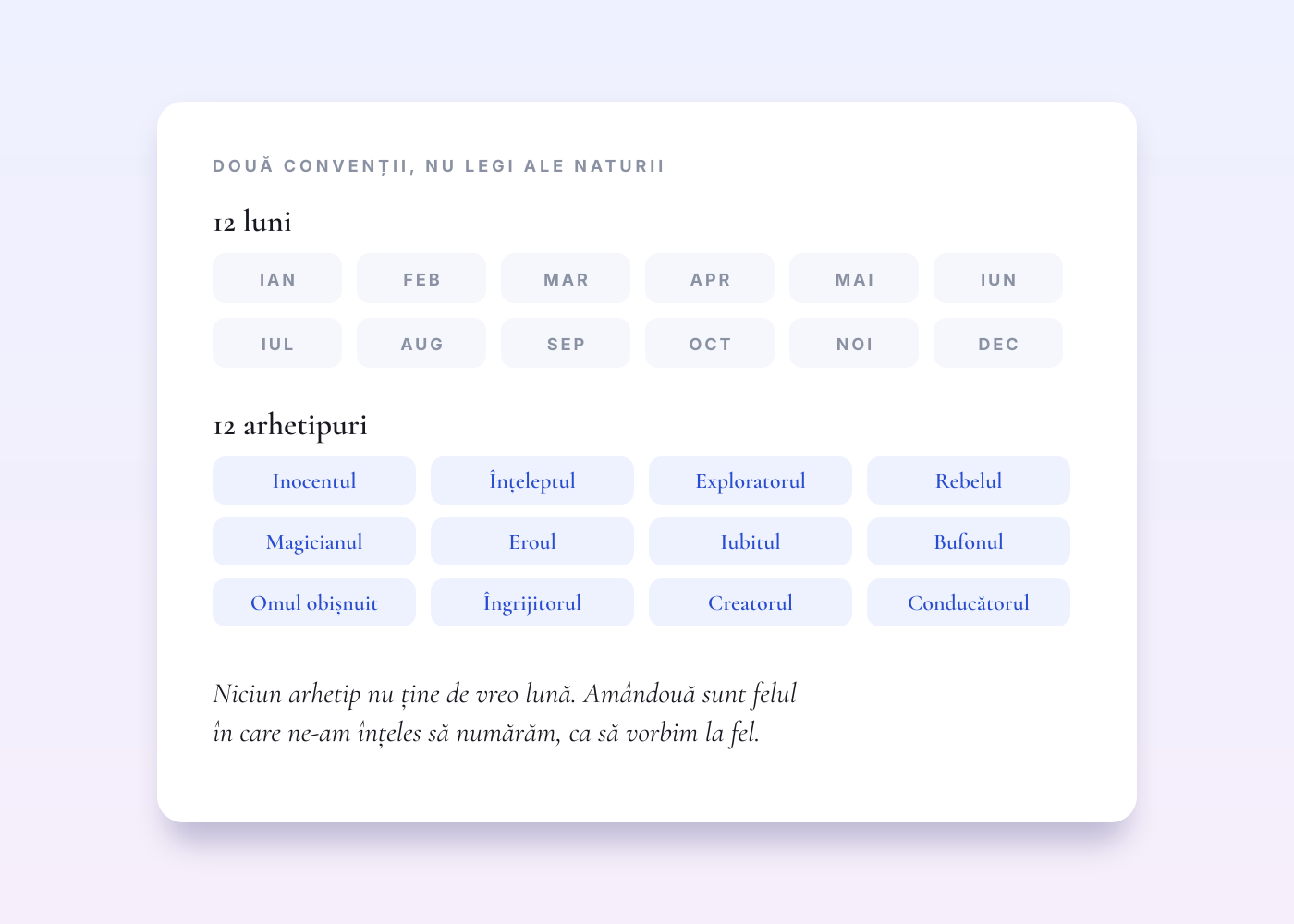
I looked at the calendar on my aunt’s wall. Twelve months are not a law of nature. The Romans started out with ten, and other cultures count differently even today. We use them because we agreed to use them, and that way we can all talk about the same day.
If it turned out tomorrow that nine archetypes describe a market better, the four perspectives, the six gaps and the distance formula would stay exactly the same. Whoever attacks the number twelve is attacking a ruler, not the measurement.
05How does an archetype become a measure?
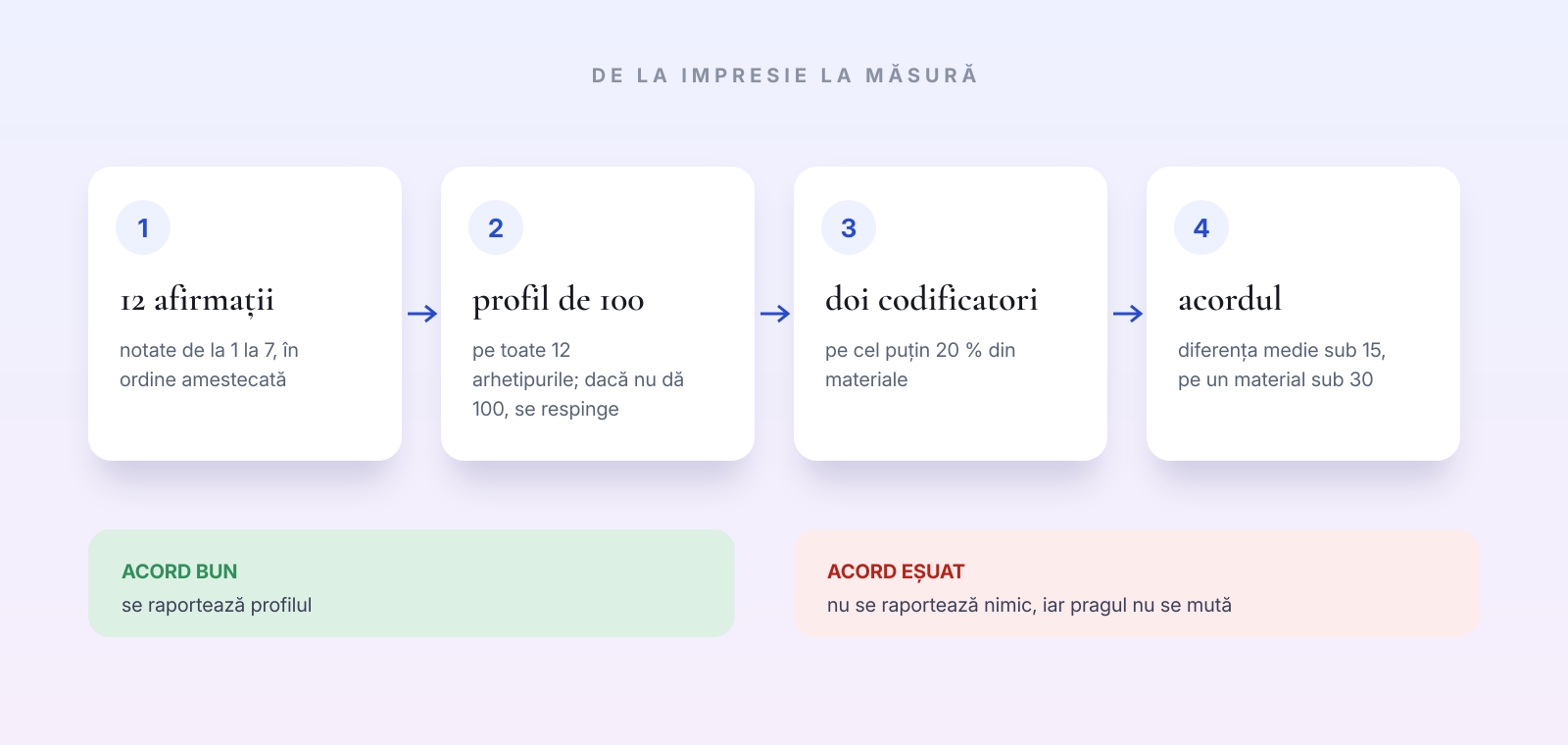
Through rules that leave no room for impressions. Management rates 12 statements from 1 to 7, in shuffled order, and the materials are coded by trained people, out of 100 points.
A profile that does not add up to exactly 100 is not quietly corrected but rejected, so that the person finds out they made a mistake. At least one fifth of the materials are coded by two people, independently. If the two differ on average by more than 15 points, or by more than 30 on a single piece of material, nothing is reported from those materials. And the threshold is not moved to get the result.
That is the feature that makes the difference in the platform: the archetype is no longer the word said with the most conviction in the meeting. It is a number that has passed through a gate.
06Do archetypes work the same way in every culture?
Not necessarily, and ACM Framework says so openly. An archetype can mean something slightly different here than in another country, but that doesn’t spoil the gaps, because all four perspectives come from the same market.
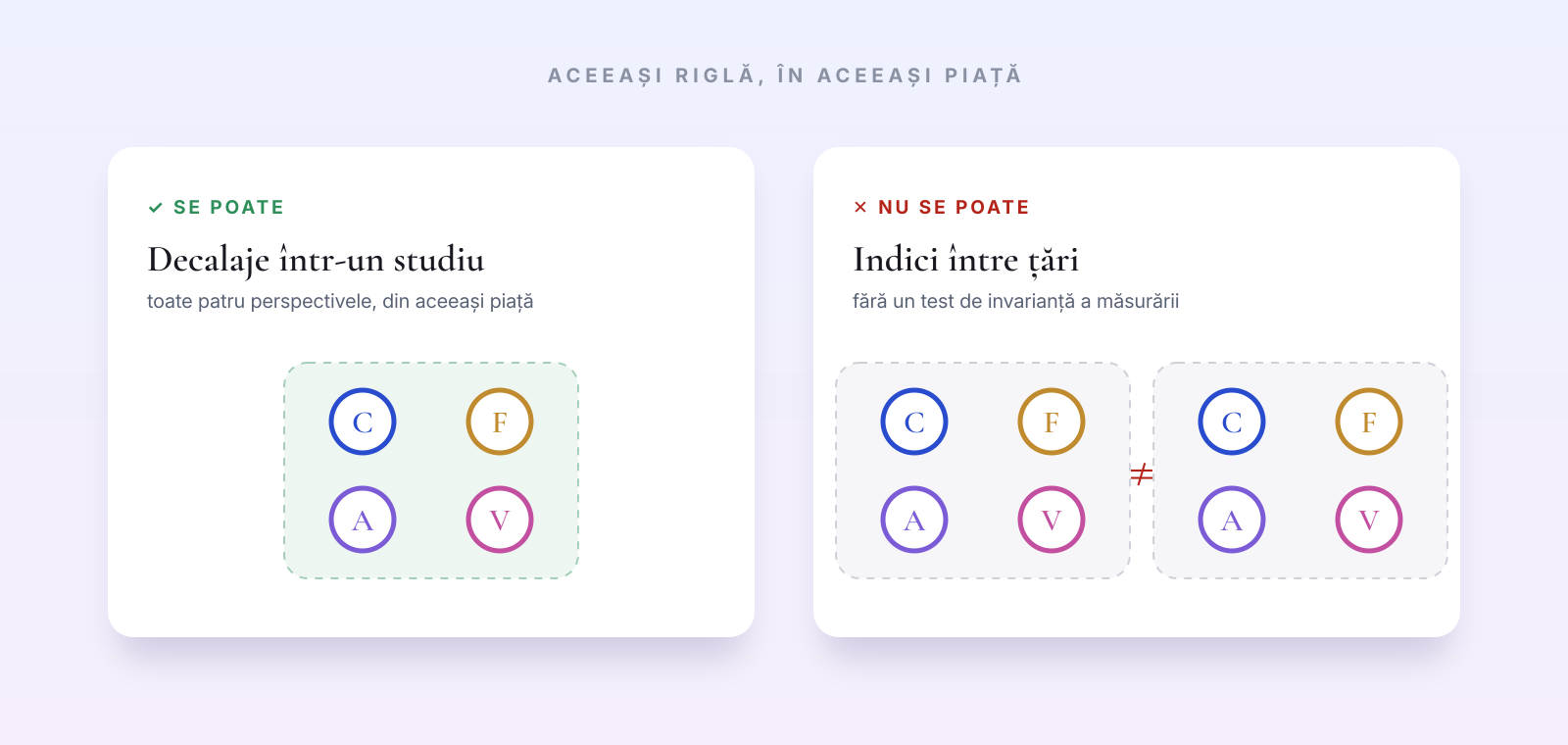
If the Outlaw means something different in Moldova than in the United States, it means the same something different for management, for the content and for customers. The ruler is graduated a little differently, but it is the same ruler for all four measurements. What you cannot do is compare the index of a brand from here with that of a brand from another country, as if it were the same scale.
07How certain is an ACM Framework number?
As certain as its rules say, and no more. The thresholds and weights are declared provisional, and small differences between profiles are read as noise, not as a result.
At the table I also said the part nobody mentions in a sales presentation. Even the best-known validated instrument for archetypes in people has borderline reliability. Measuring archetypes is hard everywhere. The difference is not that ACM Framework is perfect, but that it states its limits in advance, in writing.
Over dessert, my cousin admitted that maybe it isn’t quite like a horoscope. Then my aunt read him his horoscope for next week. The next time someone compares brand archetypes to star signs, ask them just one thing: what would happen to the result if the brand changed? With a horoscope, nothing. With ACM Framework, everything.
About the example in this article. The lunch and the family in the story are imaginary. The origin of the list of twelve (Pearson; Mark and Pearson, 2001), the rules for agreement between coders, the cultural boundary and the declared limits come from the published ACM Framework instrument.